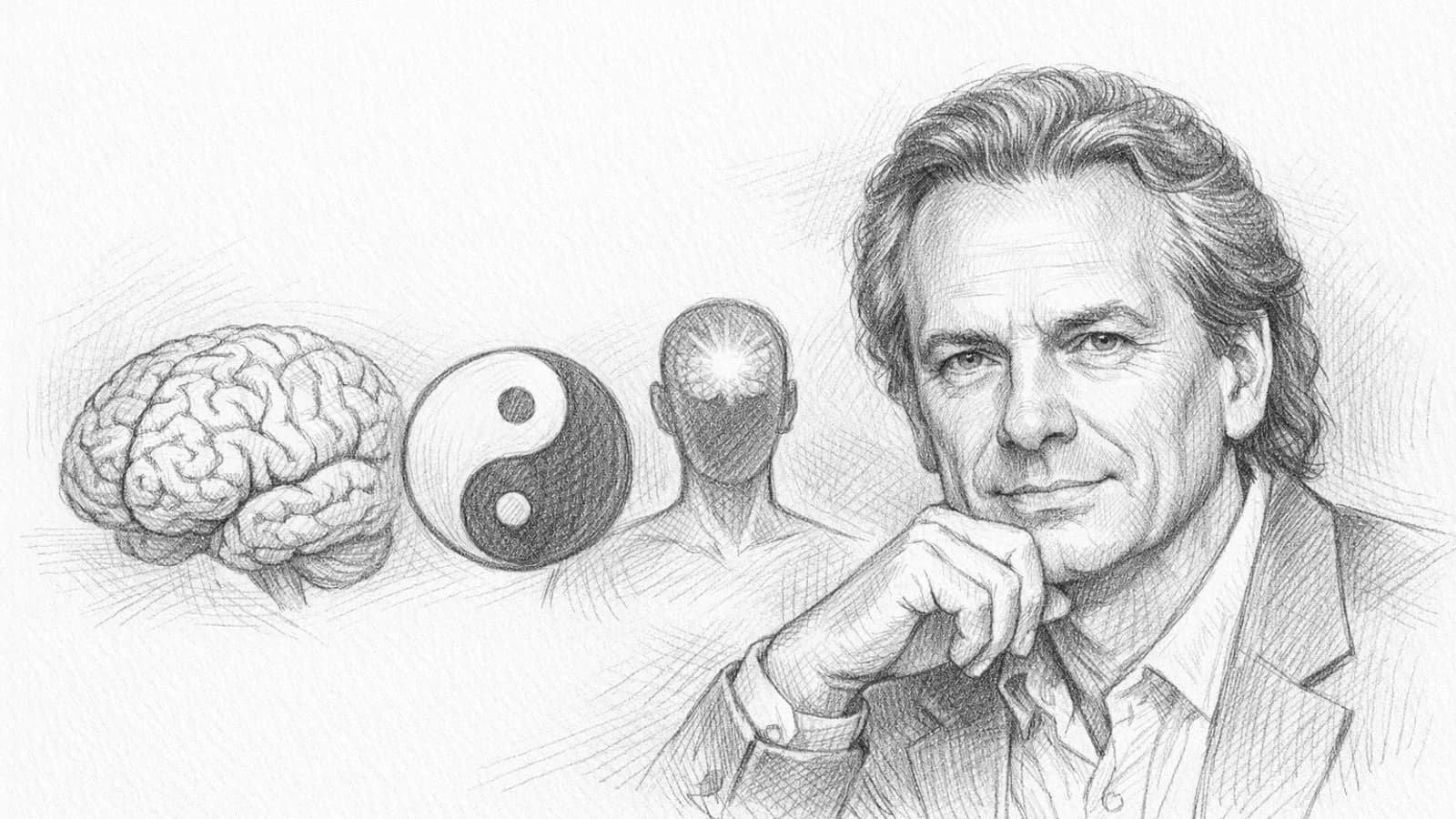
Life, Work, and Philosophy of Thorwald Dethlefsen
⚡Key Takeaways
- Thorwald Dethlefsen (1946–2010) was a German graduate psychologist, psychotherapist, astrologer, and esotericist who strongly shaped Western esotericism and holistic psychosomatics in the German-speaking world.
- His central idea was that illness is not a coincidence, but an expression of inner psychological conflict and carries a decipherable meaning.
- With books such as “Life After Life,” “The Experience of Rebirth,” “Destiny as a Chance,” and especially “Illness as a Way,” he became known to a mass audience.
- Drawing on hypnosis experiments, Dethlefsen developed reincarnation therapy and combined psychology with astrology, Hermeticism, and symbolic interpretation.
- From the 1990s onward, he increasingly turned to ritual and religious forms and founded “Kawwana – Church of the New Aeon e.V.”.
In Birkenbihl’s lectures I occasionally come across the name Thorwald Dethlefsen. So now I’ve done a bit of research into who he was and which works he published.
📚 Deep Research — Source Text
A Comprehensive Research Report on the Life, Work, and Philosophy of Thorwald Dethlefsen
Introduction: The Esoteric Turn in Psychosomatics and Spiritual Philosophy
In the late 20th century, the German-speaking world experienced a significant increase in interest in alternative explanatory models for human suffering, illness, and individual fate. At the very center of this intellectual and spiritual movement stood Thorwald Dethlefsen (1946–2010), a graduate psychologist, psychotherapist, astrologer, and esotericist who profoundly shaped and dominated the reception of Western esotericism, hermetic philosophy, and holistic psychosomatics. Through an unprecedented synthesis of depth-psychological concepts (especially C.G. Jung’s doctrine of the shadow), the astrological symbolism of the theory of rhythms, and ancient hermetic wisdom teachings, Dethlefsen radically challenged the purely mechanistic and reductionist worldview of modern natural science.
His central premise—that the human body is merely the passive projection surface for unresolved soul conflicts, and that every illness therefore carries a deep, decipherable, and purposeful meaning—provoked enormous fascination among millions of readers, but also sharp criticism in scientific, medical, and theological circles. Dethlefsen understood himself not primarily as a physician, but as a mediator of ancient initiatory knowledge that was meant to show modern people the way to salvation. This report provides an exhaustive and detailed analysis of Dethlefsen’s biography, his 20 most important philosophical and therapeutic teachings, as well as a systematic, deep-analytical examination of the 10 core statements of his late literary work “Oedipus, the Solver of Riddles.”
Biographical and Historical Context
Early Years, Academic Formation, and First Experiments
Thorwald Dethlefsen was born on December 11, 1946 in Herrsching am Ammersee. His intellectual career began within the framework of a conventional psychology degree, but even in this early phase, in the late 1960s, his insatiable fascination with the transcendent and the unconscious became apparent. In 1968, while still enrolled as a psychology student at university, Dethlefsen began conducting far-reaching hypnosis experiments. His primary goal was not to investigate ordinary therapeutic suggestion, but to release memories of supposed previous earthly lives in hypnotized people. These early experiments and the experiences that resulted from them strengthened the young student in the fundamental conviction that reincarnation was not an esoteric matter of belief, but an empirically demonstrable and therapeutically highly effective fact. This foundation determined his entire further intellectual path.
Institutionalization of Esotericism and Intellectual Influences
After successfully earning his degree in psychology, Dethlefsen quickly took the step into self-employment and founded the “Private Institute for Extraordinary Psychology” in Munich in 1973 (or 1974), which was later often referred to as the Institute for Symbolic Psychology. Within this protected institutional framework, he developed the formal concept of so-called reincarnation therapy from his student experiments. This form of therapy aimed to guide the client through a consistent and often painful process of individuation, in which repressed shadow aspects from past lives were to be made conscious and integrated.
Dethlefsen’s methodological and intellectual development during this period was strongly influenced by his teacher Wolfgang Döbereiner. Döbereiner was the founder of the so-called “Munich Theory of Rhythms,” a complex astrological interpretive system. Dethlefsen adapted central aspects of this theory of rhythms and combined them with symbolic interpretation to create his own psychological typology, which understood astrology not as fortune-telling, but as a precise psychodiagnostic instrument.
Interestingly, Dethlefsen was initially extremely skeptical of Eastern philosophies and meditation systems. However, this attitude changed fundamentally in the 1980s, when he took private yoga lessons with a teacher named “Ganga,” who had been trained in the tradition of Sivananda Yoga Vedanta. Dethlefsen subsequently integrated this practical experience with yoga and meditation into the later phases of his consciousness work and spiritual teaching. His influence on the yoga scene in the German-speaking world was reciprocal: Sukadev Bretz, later founder of the large Yoga Vidya network, explicitly cited Dethlefsen’s books as the primary intellectual trigger for his own spiritual life path. There were also documented overlaps with Wolfgang Maiworm with regard to spiritual network-building and publishing collaborations.
The Publishing Breakthrough and the Era with Rüdiger Dahlke
Dethlefsen’s literary breakthrough began in the 1970s with works such as Life After Life (1974) and The Experience of Rebirth (1976), in which he presented his hypnotic research to the public. But it was 1979 that made him an intellectual force in the esoteric scene with the publication of Fate as Opportunity. The Primordial Knowledge of Human Perfection. In this work, he outlined a generally understandable introduction to a spiritual worldview based on ancient secret teachings and uncompromisingly challenged modern natural science.
However, the absolute high point of his public impact and fame was achieved in 1983 through the publication of Illness as a Way. Interpretation and Meaning of Disease Patterns. This book, which he wrote in close intellectual partnership with physician Rüdiger Dahlke, interpreted physical symptoms of illness as valuable messages from the soul. The work sold in millions of copies, was translated into numerous languages, and became the undisputed standard work of holistic psychosomatics. The collaboration between Dethlefsen and Dahlke was intense, but ended in 1989. While Dahlke further developed the psychosomatic approach in a gentler, more integrative direction (for example with Illness as the Language of the Soul, 1992) and increasingly turned to topics such as nutrition (“Peace Food”), Dethlefsen massively radicalized his own path toward ritualism, magic, and cult.
The Theurgic Turn: The Kawwana Church and Withdrawal
From 1993 onward, Thorwald Dethlefsen underwent a profound theurgic and religious turn. He transformed his previous psychological institute in Munich into “Kawwana – Convent for Ritual Therapy.” From this emerged in 1996 the “Kawwana – Church of the New Aeon e.V.,” which was officially registered at the Munich district court. Dethlefsen led this religious community under the self-chosen, authoritarian title “Vicarius.”
The Kawwana Church marked Dethlefsen’s final departure from the broad appeal of the New Age scene toward elitist magical mystery and initiation cults. The theological and ritual basis of this community was strongly oriented toward the texts and teachings of the Zurich psychologist and esotericist Oskar Rudolf Schlag. Gnostic rituals were performed in the church and profound interpretations of the Kabbalah were practiced, with the aim of ritually “re-binding” human beings to the divine primal source.
This highly exclusive phase lasted until the beginning of the new millennium. In January 2003, the church’s semi-public events came to an end. Dethlefsen explained to his followers that the earthly structure of the Kawwana Church had fulfilled its task and had now been elevated “into the world of Briah” — a term from Kabbalistic Tree-of-Life mysticism referring to the world of creation beyond the material level. Consequently, he relinquished his title as Vicarius and withdrew completely from public life, apart from very rare occasional lectures. The architectural symbol of this phase, the temple of the church in Munich, was demolished in 2009. One year later, on December 1, 2010, Thorwald Dethlefsen died away from the public eye in Vienna, in the presence of his family.
The Literary and Rhetorical Legacy
To grasp the depth and breadth of Dethlefsen’s teachings, a look at his list of works is essential. Alongside his world-famous monographs (Fate as Opportunity, Illness as a Way, Oedipus the Solver of Riddles), it is above all his 18-volume lecture series, curated as the “Gold Edition” by Aurinia Verlag, that represents the purest source of his philosophy. This edition makes the originally oral, highly complex lectures accessible to the public and structures the theurgic and hermetic knowledge into usable categories. The following table provides a structured overview of the thematic range of this foundational work edition, which covers the full content spectrum of his teachings:
Volume / NumberTitle of Work / LectureThematic Core
Volume 01 Self-Knowledge - The Path to Awareness
Introduction to the esoteric training of consciousness.
Volume 02 Homeopathy as the Primordial Principle
Healing solely through the law of resonance.
Volume 03 Polarity and Unity
The fundamental primordial knowledge of humanity about opposites.
Volume 04 From Lead to Gold
Alchemical metaphor for psychological transformation.
Volume 05 The Word Became Flesh
Life and knowledge with the help of the cosmic law of analogy.
Volume 06 Old and New Worldview
Integration of shadow work, homeopathy, and karma.
Volume 07 The Spiritual Meaning of Christmas
The birth of inner light as a macrocosmic mirror.
Volume 08 Thoughts on the Easter Mystery
As above, so below — as in heaven, so on earth.
Volume 09 Oedipus the Solver of Riddles
The mechanisms of the salvation of the human soul.
Volume 10 Prometheus
Engagement with guilt, sin, and unity in existence.
Volume 11 Illness as a Way
Practical application of holistic, psychosomatic healing.
Volume 12 Disease Patterns
Practical, organ-specific symbolic interpretation of suffering.
Volume 13 Illness, Fate, Healing
Transformation of the psyche through the eternal laws of life.
Volume 14 Astrology and Fate
Attainment of mastery through understanding the primordial principles.
Volume 15 Astrology as Symbol
Application as a practical, diagnostic psychological typology.
Volume 16 Esotericism
The rigorous path to true self-becoming beyond the ego.
Volume 17 Reincarnation Therapy I
Methods for transforming and integrating one’s own shadow.
Volume 18 Reincarnation Therapy II
Reading and understanding in the metaphorical “book of life.”
The 20 Most Important Teachings of Thorwald Dethlefsen
The philosophical, therapeutic, and theurgic edifice of Thorwald Dethlefsen is not to be understood as a collection of independent theses, but as a strictly coherent hermetic system. He distilled highly complex esoteric, astrological, alchemical, and gnostic principles into a rigorous model of thought for coping with life and finding truth. A systematic examination of his entire literary output and lecture cycles reveals 20 central statements that define his teaching.
Ontological and Cosmological Principles
1. Fundamental Polarity and the Longing for Unity
The absolute basis of Dethlefsen’s thinking is the insight that human existence on the material plane is irrevocably bound to polarity. Human beings are forced to think, feel, and breathe in opposites (good and evil, light and dark, inhaling and exhaling, male and female). The human intellect can perceive reality only through contrast. The ultimate spiritual goal of human development—and the purpose of existence of every serious esoteric training—is, however, the return of consciousness to absolute, non-dual unity, in which all opposites are inseparably aufgehoben. The path to wholeness never requires fighting or destroying one pole (for example, the “evil” in favor of the “good”), but necessarily the synthesis and acceptance of both aspects.
2. The Universal Law of Resonance
Directly derived from ancient hermetic writings (especially the Kybalion, which Dethlefsen often cited and recommended), he postulated that in the universe, like is attracted only by like. A person can perceive and draw into his or her personal life only those aspects, people, events, and illnesses of reality for which he or she possesses a corresponding inner resonance frequency. External conflicts, accidents, or blows of fate are therefore never coincidences, but always exact physical resonance phenomena of inner, often deeply unconscious states. Whoever seeks peace in the outer world must necessarily erase the resonance for war within his or her own inner self.
3. The Law of Analogy (Microcosm and Macrocosm)
The hermetic maxim “As above, so below; as in heaven, so on earth” is the decisive epistemological tool in Dethlefsen’s methodology. He held the strict view that the structural and meaningful pattern of the entire infinite macrocosm is reflected precisely in the smallest particle and in absolute perfection in human beings (the microcosm). Esoteric disciplines such as astrology, homeopathy, and alchemy are, according to Dethlefsen, not anachronistic errors, but sciences that use this law of analogy exactly. A certain planetary primordial principle (for example Mars/aggression) corresponds analogically to a specific human organ (the gallbladder) or a particular metal (iron). Whoever understands this law can infer the invisible with infallible certainty from the visible.
4. The Perfect Illusion of Chance (The Laws of Fate)
In his influential bestseller Fate as Opportunity, Dethlefsen argued logically and relentlessly that in a highly ordered cosmos governed by resonance and analogy there can be not the slightest room for “chance.” Every event, however unjust, senseless, or tragic it may appear to the limited human ego, is the lawful, necessary consequence of prior causes in consciousness. Fate thus loses its terror as the hostile act of a punishing, personified God or a blind, cruel nature. Instead, it reveals itself as a highly precise, loving teacher who presents human beings with exactly what they still lack on the way to perfection.
5. The Law of Complementarity and the Unconscious Shadow
One of Dethlefsen’s most central and influential psychological teachings is that every pole existing in the world must be balanced by its opposite pole in order to maintain cosmic equilibrium. If a person strongly and exclusively identifies in consciousness with only one pole (for example extreme, unnatural peacefulness, altruism, or cleanliness), then he or she represses the complementary, rejected pole (aggression, selfishness, dirt) into the unconscious. According to Dethlefsen (in reference to C.G. Jung’s terminology), this unlived, demonized pole forms the “shadow.” The law inexorably forces human beings to confront this shadow in the outer world—mostly in the form of serious illness, hated enemies, or massive life crises—until they recognize it as part of themselves.
6. Reincarnation as a Necessary Cosmic Fact
Thorwald Dethlefsen vehemently refused to treat reincarnation as merely a Far Eastern religious tenet or esoteric pastime. For him, it was an empirical necessity and logical fact, without which the glaring injustice and inequality of human starting conditions and fates in the world could not be explained. Physical death is merely a transition that changes dimensions. The human soul incarnates lawfully as often as necessary until it has learned all earthly lessons through countless experiences, understood the law of analogy in depth, and transcended painful polarity into final unity through awareness.
Psychosomatics: Illness as a Carrier of Meaning
7. Illness as Symbolic Expression (The War Within)
Dethlefsen radically deconstructed the mechanistic medical model: according to his teaching, the physical body itself is absolutely incapable of being sick or healthy, since from an esoteric perspective it is merely meaningless, inanimate, and amorphous matter. Rather, the body functions exclusively as the “level of realization” of spiritual consciousness. Every illness is therefore always and without exception the material expression of an underlying soul imbalance, a “war within” that has become visible. Physical symptoms merely make visible, honestly and without compromise, what has been repressed in the psyche, and force the patient to suffer the unlived principle in his or her own flesh.
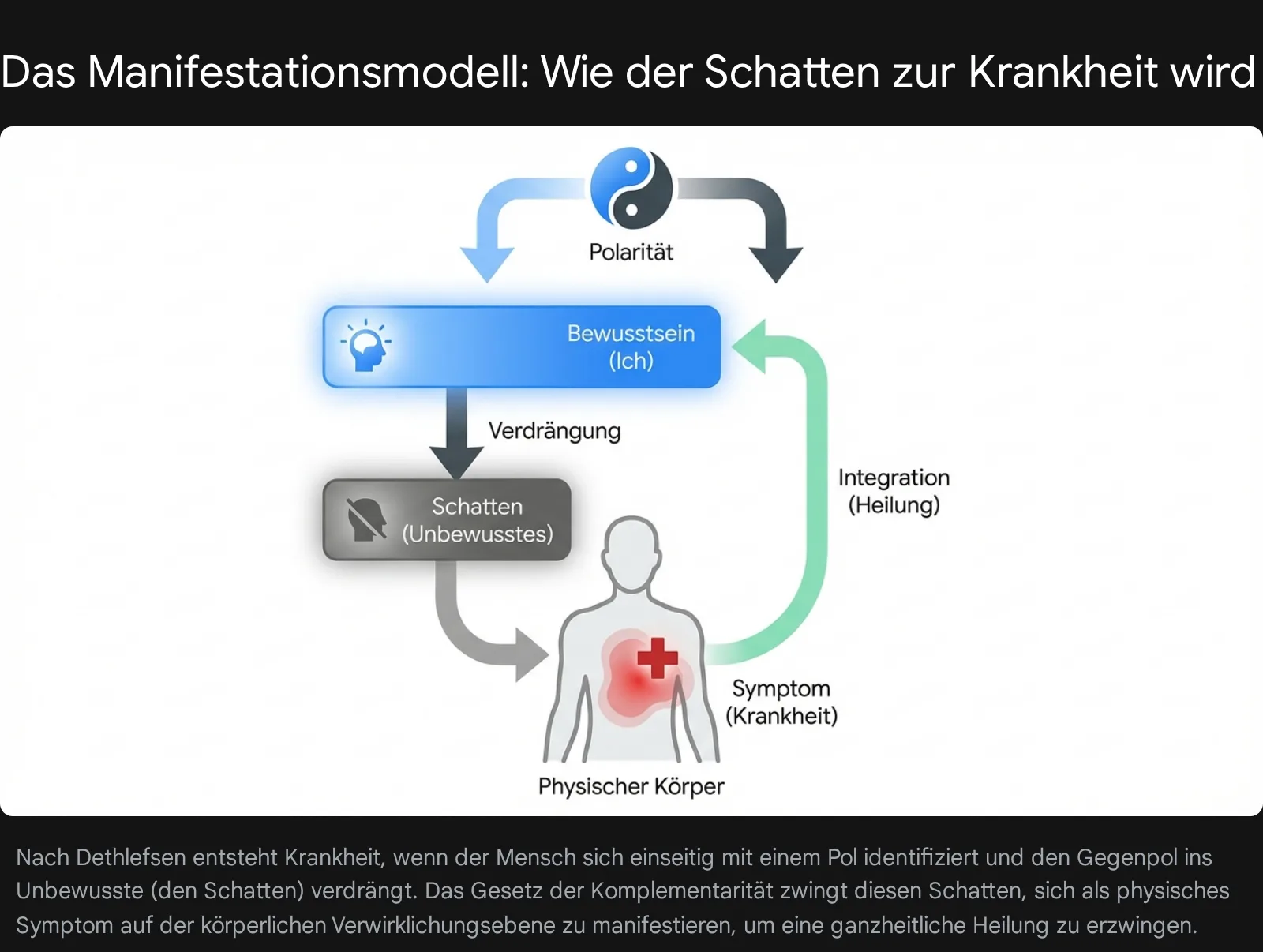
8. The Danger of Symptom Shifting in Mechanistic Treatment
A purely allopathic suppression of symptoms—for example the surgical removal of an organ or the chemical suppression of inflammation through medication—never heals the patient in Dethlefsen’s eyes. It merely shifts the problem to another level. Since the actual energetic and soul-based cause—the unintegrated shadow aspect—continues to exist unmolested in consciousness, consciousness inevitably seeks a new, often vastly more severe and life-threatening physical symptom in order to force the necessary attention to the unresolved conflict.
9. The Postulate of Absolute Personal Responsibility
From the laws of resonance and fate, Dethlefsen drew the necessary and often hard-seeming conclusion that every person must take total and uncompromising responsibility for absolutely everything that happens to them in life—including serious accidents, dramatic infections, and fatal illnesses such as cancer. The tempting psychological concept of the “innocent victim” simply does not exist in Dethlefsen’s ontology. This teaching massively challenges the comfort patterns of modern society, since it rejects blaming external pathogens (bacteria, viruses), genetic predispositions, or toxic environmental factors as impermissible, ego-driven projections.
10. Crisis, Illness, and Death as Necessary Correctives
Dethlefsen vehemently taught that illness and death should not be regarded as the ultimate enemies and fanatically fought. Rather, they fulfill a highly regulatory and spiritual function: they serve to destroy permanent human delusions of grandeur, break arrogance, and radically correct any one-sidedness in an individual’s way of life. The stubborn attempt of modern, technologized medicine to want to defeat or unnaturally postpone physical death is, from a deeply esoteric perspective, a hybrid aberration that disturbs the soul’s spiritual developmental plan.
11. True Healing as Spiritual Wholeness (Salvation vs. Mere Health)
For Dethlefsen, true healing, understood literally as “becoming whole,” means an approach to spiritual salvation and the restoration of the original wholeness of consciousness (often called enlightenment). Mere biological functioning of the body (“health” in the profane medical sense) has no inherent spiritual value so long as the consciousness of the affected person remains fragmented and trapped in the ego. Every legitimate healing treatment must bring the person at least one step closer to soul wholeness.
12. Human Beings as Naturally Sick, Needy Creatures
In a deliberate affront to humanistic and optimistic images of humanity, Dethlefsen provocatively argued that human beings are “sick by nature.” The reason lies in their nature as beings trapped in polarity, conflict-ridden, and separated. The actual “original sin,” in this context, is the fall from paradisiacal unity into the world of duality and polarity. As long as human beings possess an excluding “I,” they are separated from the divine whole and thus, in the deepest ontological sense, incurably “sick.”
Methodology, Therapy, and Transformation
13. Reincarnation Therapy as Radical Ego Dissolution and Shadow Integration
To catalyze and accelerate the spiritual path toward awareness, Dethlefsen further developed the practice of reincarnation therapy. Contrary to popular misunderstandings, this method does not aim to flatter the client’s ego by finding out whether he or she once was a famous historical personality. On the contrary: it is a highly skillful therapeutic attack on current ego identifications. Through deep hypnosis, the client is to be brought into contact with the darkest, repressed aspects of the soul—roles of perpetrator, victim, murderer, and loser from supposedly earlier lives—in order to recognize the shadow, humble the ego, and ultimately transform it.
14. Astrology as a Cosmic Psychological Curriculum
Dethlefsen did not see the constellations of planets in the birth horoscope as causal physical triggers of events (as vulgar astrology often claims). Based on the Munich theory of rhythms, he understood them as a highly complex symbolic indication of the “quality of time” at the moment of birth. The individual birth horoscope is therefore the precisely formulated “curriculum” of the incarnated soul, which unmistakably reveals the problems to be solved, archetypes to be acquired, and primordial principles to be integrated in this specific life.
15. Homeopathy as the Embodiment of the Primordial Principle
As a medical and therapeutic paradigm, Dethlefsen clearly preferred classical homeopathy alongside psychoanalysis. This is because homeopathy is entirely based on the hermetic principle of similarity (similia similibus curentur) and the process of potentiation (increase in vibrational frequency through dematerialization). This fit seamlessly into his holistic understanding of resonance and analogy. He saw homeopathy as a profoundly spiritual healing method that transfers pure archetypal information to the patient’s energy body rather than coarse material substances.
16. Alchemical Personality Transformation
Dethlefsen used the ancient imagery of alchemy for his consciousness work. The metaphorical transformation of the base metal “lead” into perfect “gold” symbolized for him the arduous process of refining consciousness. The heavy, dark, and lower instincts (the lead) of human beings must and can not be morally repressed or psychologically split off. Instead, they must be purified in the crucible of painful self-knowledge and through unsparing shadow work, and transformed into the highest spiritual qualities (the gold of enlightenment).
17. Dissolution of Ego Identification as the Ultimate Goal
The construct of the human ego is based on demarcation and separation. It defines itself solely through distinction (“I am clever, therefore I am not stupid,” “I am this and therefore not that”). Dethlefsen’s ultimate therapeutic and spiritual goal was to loosen and dissolve these artificial ego identifications of the individual step by step until the person attains the deep existential realization that the supposed outer world and one’s own inner world are ultimately inseparably one. When this boundary falls, salvation has been achieved.
18. The Inescapable Necessity of Ritual, Myth, and Cult
Especially in the late phase of his work, which culminated in the founding of the Kawwana Church, Dethlefsen tirelessly emphasized that purely dry intellectualism can never lead to spiritual salvation. Rational comprehension of the hermetic laws is not enough. To restore the severed connection (“religio”) to the divine primal ground, human consciousness requires the emotional depth and archaic force of cult, rite, symbolic action, and theurgic magic, since these address the unconscious directly.
19. The Esoteric Overcoming of the World (Escapism as the Highest Virtue)
In diametrical and deliberately provocative opposition to political, social, or ecological attempts at improving the world, Dethlefsen taught that true, authentic esoteric schools never pursue the trivial goal of “improving this material world” or even creating paradisiacal conditions on earth. The sole goal of the true esoteric is instead to see through the world as a pure learning matrix and illusion, to transcend it, and ultimately leave it behind forever through enlightenment. Material reality is not an end in itself, but gains legitimacy only as a temporary training ground for the wandering soul.
20. Criticism of the Historical Doctrine of Salvation in Christianity
Although he used Christian metaphors, Dethlefsen advocated a strictly esoteric-gnostic theology in which he regarded traditional, church-historical Christianity as largely obsolete and spiritually superseded. He considered the historical figure of Jesus to be a Son of God who, however, tragically failed in an attempt at a “solo run” toward global world salvation due to humanity’s lack of maturity. The established Christian doctrine of salvation, especially as formulated by Paul, was merely a human, theological overcompensation for this historical failure. Dethlefsen provocatively advised his advanced students to let go of Christianity, since it no longer played any role in the actual, modern occult process of salvation.
Decoding Humanity: An Analysis of "Oedipus, the Solver of Riddles"
In his late philosophical-literary work Oedipus, the Solver of Riddles - Human Beings Between Guilt and Redemption, published in 1990 (and often dated 1992 in book editions), Dethlefsen turned masterfully to Greek mythology. He uses the classical and archetypally condensed tragedies of the ancient poet Sophocles (specifically Oedipus Rex and the sequel Oedipus at Colonus) to decipher the absolute mystery of human existence, guilt, and psychological repression. A deep-psychological evaluation of the text reveals the following 10 fundamental core statements:
1. The Ancient Myth as a Universal Mirror of All Humanity
Dethlefsen understands and analyzes the Oedipus myth not as an antiquated historical narrative or merely an entertaining ancient drama. He identifies it as the fundamental, eternally valid mystery of our very humanity. Oedipus is not just an unfortunate king of Thebes; he stands symbolically for the universal basic pattern of every human fate. Human life unfolds inevitably in the harsh polarity between unavoidable, existential guilt and ultimate, necessary failure.
2. Ancient Tragedy as a Lost, Highly Effective Collective Psychotherapy
In ancient Greece, theatre, in Dethlefsen’s understanding, had a primarily religious, cathartic, and depth-psychologically healing function. Through empathic identification with the “faceless figures on stage” and shared experience of their dramatic fate, the polis community could free itself in a socially accepted way from enormous psychic pressure and accumulated unconscious conflicts. In his work, Dethlefsen deeply and explicitly laments that this highly effective form of institutional “collective psychotherapy” has been irretrievably lost in the intellectualized, materialistic culture of modernity, which leads to a massive increase in neuroses and psychosomatic disorders.
3. The Fateful Psychological Mechanism of Projection
The central philosophical problem of modern human beings is—entirely analogous to King Oedipus before his painful realization—the projection of their own shadow aspects. People continually, aggressively, and combatively deal with issues, problems, and persons in their external environment, in the blind, naive belief that evil lies outside. As the plague rages in Thebes, Oedipus feverishly, analytically, and with righteous anger searches for the fugitive murderer of the old king Laius. In doing so, he does not realize that he himself is the sought-after culprit who brought disaster upon the city. The esoteric truth is: the roots of all conflicts, wars, and problems always lie within ourselves, even if deeply unconscious.
4. The Fatal and Tragic Paradox of Intelligence
One of Dethlefsen’s deepest psychoanalytic, philosophical, and epistemological insights in this book concerns the nature and drastic limits of the human intellect. Oedipus shines through his outstanding logical acuity: he solves the legendary riddle of the Sphinx, a fearsome and monstrous figure of nature, with mere, cold intellectual power. Yet it is precisely this superior, ego-driven intelligence and ability to combine that fail miserably and completely when it comes to understanding the prophetic oracle pronouncements from Delphi and correctly interpreting the spiritual, fateful signs in his own life. The intellect can master external, phenomenal matter and defeat monsters, but remains completely blind to the true nature of the soul and to one’s own karma.
5. The Unconscious, Unintentional Steps into Absolute Catastrophe
The psychoanalytic depth and originality of Dethlefsen’s interpretation of the Sophoclean material become especially clear in his emphasis on the “unintentional steps toward catastrophe.” He stresses that Oedipus was not driven by base lust for power when he killed King Laius at the crossroads and later became king of Thebes. Nor did he act as a calculating, knowing patricide. Rather, he acted in an “angry frenzy” arising from a fundamental, unconscious ignorance of his own shadow aspects. Fate is fulfilled not through conscious malice, but through lack of awareness.
6. The Fatal Lack of Spiritual Initiation and Self-Exploration
According to Dethlefsen’s analysis, the reason King Oedipus plunges so inexorably and tragically into his predetermined fate is primarily that he is an “uninitiated” person who has refused inner alchemy. Although throughout his life in Corinth there were repeatedly distressing rumors that he was a foundling and not the biological son of the local royal couple, he shamefully failed to investigate his true origin honestly and deeply. He preferred the comfortable appearance. Without a willingness to undergo true initiation into the painful mysteries of the self and one’s psychological roots, human beings stumble blindly into inescapable guilt and karmic entanglement.
7. The Hybrid, Unnatural Character of Intellectual Deciphering
Dethlefsen connects to a profound culture-critical philosophy (strongly related to Nietzschean theses about the birth of tragedy and myth), according to which the triumphant solving of the Sphinx’s riddle was a violent, anti-natural act of intellectual disenchantment. Whoever forces nature to reveal its deepest, instinctive secrets—and thereby “successfully resists it” with reason—commits an enormous violation of nature. The inevitable karmic consequence of this rational hubris and technocratic dominance over the unconscious is that Oedipus, as compensation, must also break the most sacred, tabooed natural orders through patricide and unwitting incest (his marriage to his mother Jocasta). Nature defends itself against intellectual rape through the destruction of the individual.
8. The Transformation of the World Through Exclusive Self-Knowledge (Resonance)
An extremely practical, psychological, and almost magical conclusion from the work is the applied principle of inner causality. As Dethlefsen put it succinctly: human beings never need to fight the world; they only need to change themselves, and the entire world changes immediately and lawfully with them. Since the outer world in the hermetic worldview is only a mirror of the inner world (exactly like a physical mirror that immediately smiles back when one decides to smile oneself), every revolutionary or political struggle against external reality is obsolete, inefficient, and a sign of insufficient esotericism.
9. The Absolute Inevitability of Guilt and the Necessity of Failure
In Dethlefsen’s strict and illusionless ontology, there is no concept of a morally “pure,” sinless, or merely happy life. Every human incarnated in matter necessarily acts in the painful polarity between fated guilt and inevitable failure. Oedipus must fail in grand style and be deprived of all worldly power, reputation, and wealth. The immense suffering, the outbreak of plague in Thebes, and the extremely cruel revelation of the unbearable truth are, from an esoteric perspective, not senseless punishments by angry gods. They are the indispensable, purifying mechanisms that break the intellectual hubris of the ego and make the spiritual path to salvation into wholeness possible in the first place.
10. Final Redemption Through the Rigid Path Inward (Blinding as Metaphor)
The final, most powerful, and most important teaching of the myth manifests itself in Oedipus’s shocking self-blinding at the dramatic end of the tragedy. After recognizing the terrible truth of his existence, he tears out his own eyes with the golden brooches of the dead Jocasta. Dethlefsen interprets this drastic act not as a mere act of despair, madness, or self-punishment. He sees in it a deep, archetypal, and spiritual symbolism: in order to attain redemption, human beings must literally and metaphorically strip off the outer world. They must necessarily stop continually looking with their physical senses into the material, dual world, which is in any case only illusion. They must learn to direct the focus of perception in an undivided and radical way inward, toward their own divine core of being. Only in the complete renunciation of the worldly outer world, in total inner vision, does the soul find its final, liberating salvation.
Reception, Impact History, and Academic Criticism
Thorwald Dethlefsen’s intellectual work has left an immensely lasting, though in the history of science highly polarizing and controversial, trace in Western alternative medicine, psychology, and modern esotericism.
Criticism from Modern Natural Science and Academic Medicine
The strongest, most well-founded, and most unyielding opposition to Dethlefsen’s teachings, especially regarding the theses from Illness as a Way, came understandably from institutionalized academic medicine and evidence-based empirical psychology. In countless publications, the strict and monocausal psychologization of all conceivable physical ailments was particularly attacked on scientific grounds. By seeking the causes of illness—whether acute bacterial infections, oncological findings such as cancer, or even mechanical injuries from accidents—solely in the hermetic field of resonance of the individual and his or her unconscious shadow side, Dethlefsen denied and neglected the massive, measurable influences of physical lifestyle (nutrition, exercise), genetic predispositions, and serious social and ecological environmental factors.
Medical ethics committees and numerous patient associations also repeatedly accused him of engaging in ruthless, cynical “blame shifting” toward seriously ill and vulnerable patients with his fundamentalist thesis of “absolute personal responsibility.” Through the esoteric dictum that even the cruelest illness is the deserved karmic consequence of insufficient spiritual insight and repressed shadow material, enormous, toxic psychological pressure is created among patients who are morally and spiritually made to pay for their biological and often random suffering. Moreover, the epistemological and philosophical basis of the central “law of analogy” was sharply rejected as a pre-scientific, mythological construct and arbitrary invention.
Theological Criticism and Sectarianism
From institutional theological circles as well, above all the Protestant Central Office for Worldview Questions (EZW), Dethlefsen encountered massive, dogmatic criticism over decades. The EZW stated in numerous reports that Dethlefsen’s reincarnation-therapeutic concept, especially once it later fused with his magical-ritual orientation, displayed strong narcissistic, elitist, and undeniably sect-like traits. His open devaluation of historical Christianity as a failed religious project, his recommendation that clients leave Christianity behind as “outdated,” and, not least, his almost messianic self-staging as “Vicarius” in the strictly hierarchical, undemocratic structure of the Kawwana Church met with fundamental theological rejection. Observers and former members noted critically that his enormous personal charm and the magical claim with which he drew highly intelligent people into his institutional orbit often took on authoritarian and manipulative traits in practice.
Sustainable Influence in the Holistic Scene and the Legacy
Despite this multi-layered, professionally grounded criticism from science and the church, Thorwald Dethlefsen remains unquestionably a decisive, epochal thought leader of systematic esotericism throughout the German-speaking world. His concept of symbolic disease interpretation is today—often in a much softened, more consumable form through successors, former companions such as Rüdiger Dahlke, and modern mind-body physicians—deeply rooted in the collective understanding of alternative medicine and in large parts of holistic psychosomatic counseling.
Even in completely different, at first glance disjunct spiritual disciplines, his intellectual reach was felt and formative: for example, Sukadev Bretz, founder of the mass-reaching Yoga Vidya movement (Europe’s largest yoga network), explicitly cites Dethlefsen’s depth-psychological books as the primary intellectual trigger for his own far-reaching spiritual path. Although the physical, architectural existence of his occult Kawwana Church ended definitively with the demolition of its temple in 2009 and Dethlefsen himself died one year later, the synthesis of hermetic philosophy, psychological astrology, C.G. Jung’s depth psychology, and ritual symbolic interpretation that he masterfully popularized lives on uninterrupted in numerous esoteric training systems, therapeutic practices, and in literature.
Ultimately, Dethlefsen’s radical intellectual approach was to return uncompromisingly to the modern, technologically alienated, and meaning-seeking person the absolute, indivisible responsibility for his or her own fate. In a world in which suffering is increasingly interpreted as statistical chance, genetic defect, or mere bad luck, he provided, through works such as the lecture series and literature like Oedipus, the Solver of Riddles, a highly complex, self-contained metaphysical explanatory pattern. This model compels people to introspection and interprets blows of fate, crises, and illnesses with an unforgiving, almost mathematical logic as absolutely necessary lessons on the soul’s eternal path toward spiritual perfection.
❓ Frequently Asked Questions
Who was Thorwald Dethlefsen?
Thorwald Dethlefsen was a German graduate psychologist, psychotherapist, astrologer, and esotericist. He became especially well known for his books on reincarnation therapy, psychosomatics, and the spiritual interpretation of illness.
What is Thorwald Dethlefsen known for?
Dethlefsen became best known for the claim that illness is a message from the soul and has a deeper meaning. His book “Illness as a Way” is considered his best-known work and a standard text in holistic psychosomatics.
Which books by Thorwald Dethlefsen are especially important?
His most important works include “Life After Life” (1974), “The Experience of Rebirth” (1976), “Destiny as a Chance” (1979), and “Illness as a Way” (1983). These books established his reputation as an influential author in the esotericism scene.
What is Thorwald Dethlefsen's philosophy?
Dethlefsen combined psychology, astrology, Hermeticism, and reincarnation ideas into a symbolic worldview. He understood symptoms, fate, and illness as clues to unconscious or soul-level processes.
What was Thorwald Dethlefsen's Kawwana Church?
The Kawwana Church of the New Aeon e.V. was the religious and ritual community that Dethlefsen established from the 1990s onward. It marked his shift away from broad New Age publishing toward initiatory and magical rituals.
Keep reading
More from this topic15 Beliefs for Success & True Happiness
Which beliefs really move you forward? Here you’ll get 15 fitting affirmations for success, health, and more happiness — ready to use right away.
How to Use Your Subconscious as an Advisory Board
Leave the thinking to your subconscious: with 12 Invisible Counselors, you’ll make better decisions faster — instead of overthinking endlessly. Start now!
The world would look completely different today without Tesla
Without Nikola Tesla, technology would be different today: Discover which inventions shaped our world—and what would be missing without him. Read now!