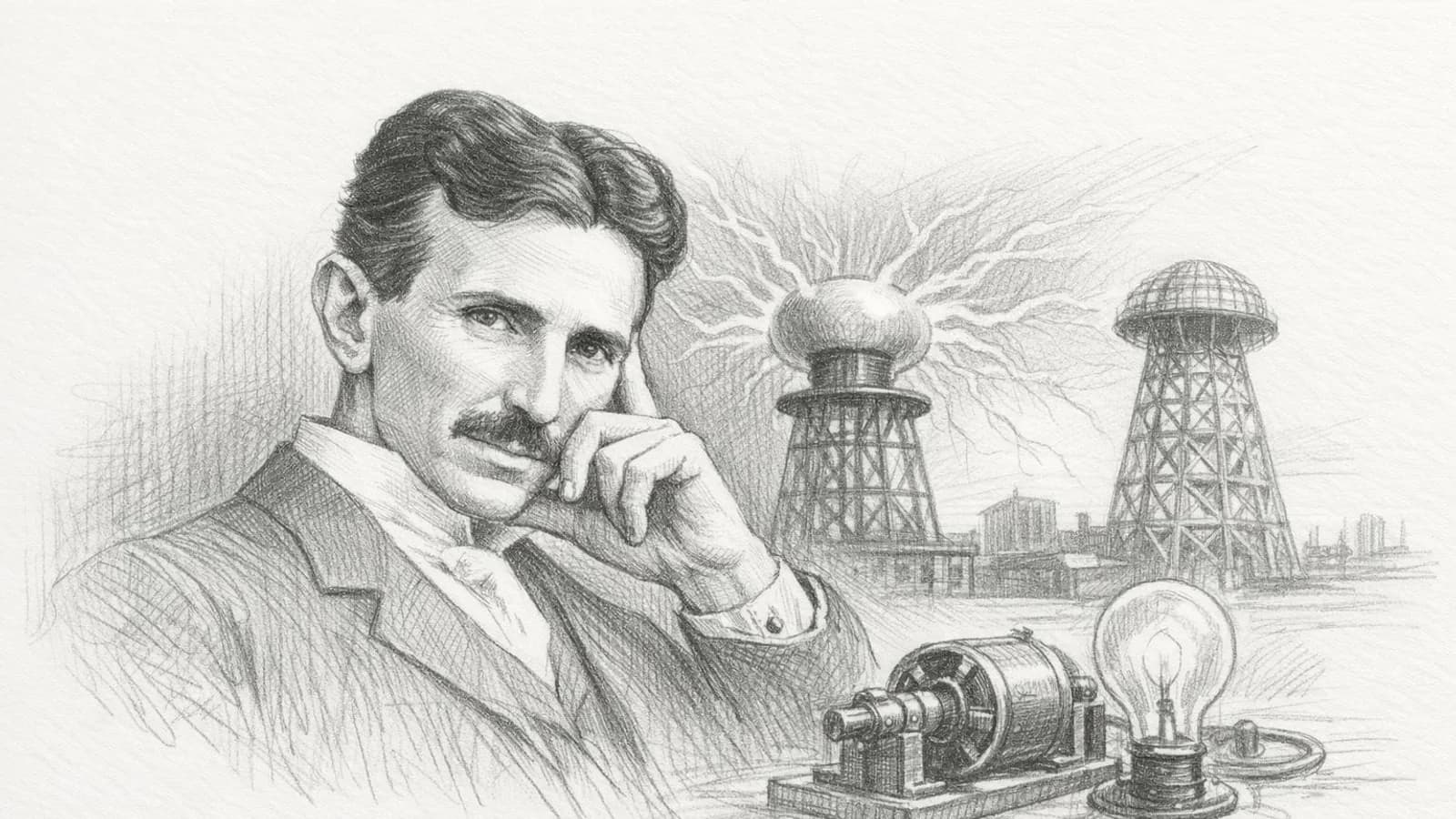
The world would look completely different today without Tesla
⚡Key Takeaways
- Nikola Tesla was a key figure in electrification and wireless radio communication; without his work, the modern world would look very different technologically.
- Tesla’s most important achievements include the polyphase AC system, teleautomatics, medical technology, and the bladeless turbine.
- The article attributes his extraordinary inventive power to a combination of his father’s intellectual influence and his mother’s practical inventive spirit.
- An early family trauma caused by the death of his brother Dane is said to have had a lasting impact on Tesla’s work ethic and his almost ascetic lifestyle.
- Tesla worked with a unique cognitive architecture: he could simulate, test, and refine complex machines and physical processes in his mind.
Nikola Tesla has an impressive résumé. It is extraordinary what he invented. And possibly, without censors, even more would have been revealed. Without him, the world today would definitely be a different one.
Read the Deep Research for yourself or use the audio feature. It is worth it.
📚 Deep Research — Source Text
Comprehensive research report on the biography, cognition, and technological significance of Nikola Tesla
1. Introduction to the Tesla Paradigm
The historical discourse on the technological and industrial innovations of the late 19th and early 20th centuries is significantly dominated by a singular historical figure: Nikola Tesla. As a polymathic engineer, physicist, inventor, and visionary, Tesla created the infrastructural and theoretical foundations of modern electricity supply and wireless radio communication. His intellectual legacy extends far beyond the mere construction of rotating machines; it reveals a unique, almost unparalleled cognitive architecture that enabled him to deconstruct, test, and reorder complex physical laws through pure mental simulation. In an era characterized by the transition from mechanical steam power to universal electrification, Tesla served as the primary architect of this transformation.
This research report provides a thorough, multidimensional analysis of Tesla’s life, his scientific work, and his psychological structure. It examines the biographical influences of his childhood in the Austro-Hungarian province, his formal academic training at the leading polytechnic institutes of Central Europe, and especially the radical cognitive learning and working methods that fueled his unparalleled inventiveness. In addition, it traces chronologically and analytically at what age and through which specific milestones he achieved his international breakthrough and how he became the defining figure of the so-called “War of Currents.” A detailed taxonomic examination of his core fields and inventions—from the revolutionary multiphase alternating-current system to teleautomation and medical technology, and on to the fluid mechanics of the bladeless turbine—makes clear the complexity of his oeuvre. By synthesizing historical fragments, psychological profiles, and detailed technological patent analyses, a holistic picture emerges of a humanist and scientist whose intellectual paradigms often far outstripped the economic and technological realities of his time and continue to resonate into the digital age.
2. Origins, family, and early psychological imprinting
The genesis of Tesla’s extraordinary cognitive abilities and his tireless pursuit of scientific knowledge can only be adequately contextualized through a detailed consideration of his family and sociocultural origins. Nikola Tesla was born on the night of July 9 to 10, 1856, during a severe thunderstorm in the small village of Smiljan. This village lay in the region of Lika, which at the time was part of the Croatian Military Frontier within the Austrian Empire (later Austria-Hungary). Although he grew up in a multicultural environment and considered himself a cosmopolitan and world citizen throughout his life, he came from a Serbian family and was deeply rooted in the Serbian Orthodox tradition. In his later U.S. patent applications, before he obtained American citizenship, he proudly identified himself as coming from the “frontier region of Austria-Hungary.”
2.1 The parental dualism: intellect, eidetics, and rhetoric
Tesla’s intellectual foundation resulted from a remarkable parental dualism that linked deductive logic with intuitive, mechanical creativity. His father, Milutin Tesla, was a Serbian Orthodox priest, a gifted preacher, and a philosophical writer. Milutin embodied the formal, rhetorical, and literary side of education. He had the peculiar psychological habit of speaking intensely to himself; he often carried on heated, polyphonic arguments in empty space, changing the tone of his voice so that an unsuspecting listener might have sworn several people were in the room. This trait points to an extremely vivid inner imagination and a high degree of dialectical thinking, which he passed on to his son.
Far more formative for Tesla’s technical genius, however, was the genetic and educational disposition of his mother, Đuka Mandić. Although she remained illiterate throughout her life and had no formal schooling whatsoever, she possessed a brilliant, highly analytical mind. She came from a long line of inventors and tinkerers. In her free time, she constructed and invented clever household and agricultural devices, spun the finest threads with self-made tools, and organized the entire family estate. Moreover, she had such a pronounced eidetic (photographic) memory that she could effortlessly recite epic Serbian poems and long literary passages from memory, even though she had never read them herself. Her resilience also showed in times of crisis: at the age of sixteen, during a deadly plague or cholera epidemic, she independently cared for the dying members of a neighboring family. Tesla himself traced the origin of his own genius, inexhaustible inventive power, and photographic memory directly to his mother’s genetics and practical influence. This dualism—the father’s abstract logic and the mother’s eidetic, mechanical intuition—formed the ultimate breeding ground for Tesla’s later power of visualization.
2.2 The trauma surrounding his brother Dane and the psychological consequences
Tesla’s childhood was deeply marked by a family trauma that would have fundamental effects on his later psychological structure and obsessive work ethic. Nikola was the fourth of five children; he had an older brother named Dane and three sisters (Angelina, Milka, and Marica). Dane was regarded in the family as the absolute favorite, a highly gifted prodigy whose intellect and talent, in the parents’ eyes, supposedly far exceeded Nikola’s.
When Nikola was five years old, Dane, then twelve, died in a tragic accident. Historical sources differ slightly regarding the exact cause of death; some reports speak of a fall from a horse, while other, more detailed accounts suggest that Dane fell from a loft ladder during a childish scuffle with Nikola. Regardless of the exact mechanics of the accident, the event left deep, lifelong scars on Tesla’s psyche. Throughout his life, he felt inferior in comparison with his idealized, deceased brother. Psychological retrospectives suggest that this massive survivor syndrome and the constant feeling of being unable to fulfill parental expectations after the loss of the family’s firstborn catalyzed Tesla’s extreme, almost mechanical drive to work. He devoted his life to research like a “monk of the scientific community,” driven by deep melancholy, a withdrawal from worldly pleasures, and a restless pursuit of technological perfection. Some analysts even draw parallels here to the biblical Cain-and-Abel motif: the survivor is marked, yet at the same time endowed with an extraordinary, almost superhuman gift that drives him restlessly through the world.
2.3 The life-threatening illness and the pact with his father
Another life-changing turning point occurred in Tesla’s late adolescence. After the family moved to the nearby town of Gospić in 1862, he attended primary and secondary school there. His father vehemently insisted that Nikola continue the family tradition and pursue a career as an Orthodox priest or alternatively in the military. This prospect filled the boy, who was interested in the natural sciences, mechanics, and mathematics, with deep despair.
After finishing school, Tesla returned to Gospić and shortly afterward contracted cholera, a disease that ravaged the region in a devastating epidemic. Tesla hovered between life and death for nine months; his condition steadily worsened, and the doctors nearly gave up on him. In a moment of utmost physical and mental exhaustion, he wrung a solemn promise from his desperate father at the bedside: if he recovered improbably, he would be sent not to a seminary, but to one of the best engineering schools in Europe. His father, willing to do anything to save his remaining son, agreed. Tesla then recovered almost miraculously, and his path into science was finally sealed.
3. Academic training and intellectual formation
Although Tesla is often regarded in modern pop culture as the epitome of the isolated, self-taught genius, in his youth he received an extremely rigorous, structured, and elite Central European education before leaving the purely academic path. His academic career was marked by extreme brilliance, but also by conflict with established doctrines.
3.1 The Higher Real Gymnasium in Karlovac (1870-1873)
At the age of 14, in 1870, Tesla moved in with his aunt and uncle (a retired colonel of the Military Frontier) in Karlovac (Carlstadt) to attend the renowned “Higher Real Gymnasium” (Imperial-Royal Higher Realschule) there. The school was located in the Croatian-Slavonian Military Frontier, which is why instruction was conducted strictly in German. Here Tesla came into profound and systematic contact with physics and the phenomena of electricity for the first time.
A progressive and demanding curriculum, led by his charismatic physics professor Martin Sekulić, awakened in him a lifelong fascination. Sekulić demonstrated physical principles using fascinating laboratory apparatus and experiments, which sparked in Tesla a deep desire to master these invisible forces. In his autobiography, Tesla specifically recalled mechanical models of water turbines in the classroom, which he operated with great delight. These models shaped his early, audacious wish, which he then told his incredulous uncle: one day to travel to America in order to harness the gigantic power of Niagara Falls with a massive water wheel—a vision he would realize exactly thirty years later. Thanks to his enormous grasp of material, Tesla completed the standard four-year gymnasium program in just three years and graduated with distinction in 1873 at the age of 17.
3.2 Graz University of Technology (1875-1878) and the conflict over direct current
After recovering from cholera and equipped with a scholarship from the Military Frontier, Tesla enrolled in 1875 at the k.k. Polytechnic Institute (today’s technical university) in Graz to study engineering and physics. In his first year, he displayed an almost superhuman work ethic; he worked systematically from 3 a.m. to 11 p.m., seven days a week, without regard for weekends or holidays. He passed all exams with the top grade “Excellent” (with the sole exception of an examination on the congruence of numbers with Professor Rogner, which he completed with “Good”). The professors quickly recognized the budding genius of their student.
The absolutely decisive intellectual spark that would define Tesla’s entire later life struck in 1877. In a lecture by Professor Jakob Pöschl, Tesla observed the function of a novel Gramme dynamo machine operating on direct current (DC). Tesla noticed strong sparking and high friction losses at the machine’s commutator. He stood up and boldly suggested that by using alternating current (AC) one could dispense entirely with the inefficient commutator. Professor Pöschl dismissed this idea before the entire audience as physically completely impossible and compared Tesla’s proposal to trying to build a perpetual-motion machine. In retrospect, this academic conflict was the absolute catalyst for Tesla’s genius. The public rejection by academic authority did not discourage him; rather, it fanatically drove him to solve the problem of current-free power transmission in the secrecy of his own mind.
Toward the end of his time in Graz, however, Tesla lost his life-saving scholarship due to political restructuring in the Military Frontier. Under immense financial and psychological pressure, he temporarily fell into gambling addiction, neglected his studies, and ultimately dropped out between September and November 1878 without a formal degree. Out of deep shame before his family, whom he did not want to admit failure to, he disappeared, broke off all contact, and worked briefly as a simple draftsman in Slovenian Maribor before his worried father tracked him down and brought him back to Gospić.
3.3 Charles University in Prague (1880) and the transition into industry
After his father’s death in 1879, Tesla fulfilled his last wish and attempted in 1880 to continue his studies at the renowned Charles University (Charles-Ferdinand University) in Prague. There he attended lectures in advanced physics and higher mathematics. However, because he could not prove the mandatory subjects of Greek and Czech at gymnasium level, he was only allowed to enroll as a guest auditor and could not receive official grades. This academic episode, too, was short-lived. Driven by chronic financial hardship and the pressing desire to put his theoretical ideas into practice, he left Prague after just one year without a degree in order to move into the emerging telecommunications industry in Budapest.
4. Cognitive architecture, learning methods, and mental training
The real core of Tesla’s historical singularity and immense productivity lies less in his formal qualifications than in his extreme cognitive work techniques. He possessed not only a photographic memory in the conventional sense, but also developed imagination into a highly precise, error-free technical design instrument.
4.1 Early childhood cognitive training by his father
A crucial, often overlooked factor in the development of Tesla’s neural architecture was the systematic mental exercise he had to undergo as a child under the strict guidance of his father. His father deliberately aimed to sharpen the boy’s memory, logical deduction, and critical sense. These daily, intensive lessons included:
Guessing thoughts: Empathically and logically anticipating the intentions and thoughts of another person in order to train intuition and social insight.
Defect discovery: The analytical, microscopic search for logical breaks, construction flaws, or semantic weaknesses in physical forms or linguistic expressions.
Memory drills: Flawlessly repeating extremely long, complex sentences from memory after hearing them only once.
Mental arithmetic: Performing highly complex mathematical calculations in one’s head without using pen or paper.
This early, relentless neurological stimulation laid the foundation for Tesla’s later ability to use his brain like an extremely high-resolution physical simulator.
4.2 “Mental prototyping” and absolute visualization
In his youth, Tesla’s extraordinary visualizations often manifested uncontrollably as blinding flashes of light, blended with such vivid inner images that they were indistinguishable for him from physical reality—a phenomenon bordering on strong synesthesia or a form of productive hallucination. Over the years, however, he developed strict psychological strategies to gain complete mastery over these visions. He undertook nocturnal “mental journeys” in which he explored foreign cities in his thoughts, traversed landscapes, and met new people who appeared as real to him as in the physical world.
In his work as an engineer, this ability culminated in a method that, in modern terms, would be described as error-free “mental prototyping” or mental CAD (computer-aided design). While conventional inventors such as Thomas Edison relied almost exclusively on purely empirical methods (“trial and error”)—an inefficient approach Tesla deeply despised and about which he mocked that it wasted far too much time and material—Tesla almost never drew plans on paper during development and built no physical preliminary models. He conceived a machine entirely in his mind’s eye, modified dimensions, changed materials, corrected tolerances, and let it “run” mentally.
The depth of detail in these mental simulations was so immense that he could operate a turbine in his mind for weeks, then mentally inspect the wear and tear of its components with exactness, as though the machine had really run. As he stated unambiguously in his autobiography My Inventions: “It is absolutely all the same to me whether I test my turbine in my mind or in my workshop. I see no difference in the results.”. This superhuman ability saved him enormous amounts of time and money and allowed him to dictate error-free construction plans directly from his head to his machinists; the machines built from these mental blueprints generally worked perfectly upon first assembly.
4.3 Emotional linkage in learning
Beyond pure mechanical visualization, Tesla also used emotional stimuli to encode information and new concepts deeply into his neural networks. He deliberately provoked intense feelings—whether curiosity, excitement, or even instrumentalized anger over his own lack of knowledge—before turning to new subjects. He instinctively understood what modern neuroscience confirms today: the brain stores information much more sustainably and quickly when it is linked to a strong emotional reaction. He internally simulated the existential pressure of having to understand this knowledge at any cost, which made his learning speed far surpass that of his contemporaries.
5. Linguistic excellence and literary influences
Tesla’s enormous capacity for absorption and mental power was reflected not only in physics, but in a remarkable way also in his linguistic abilities. He was a highly accomplished polyglot and spoke eight languages fluently. This linguistic versatility was not an end in itself, but a crucial tool for his scientific and commercial success. It enabled him to study physics research literature from all over Europe in the original, work seamlessly in various international locations, and later, in the United States, to persuade investors as a polished, cosmopolitan speaker from many different cultures.
LanguageAcquisition context and strategic value for TeslaSerbo-Croatian
His native language; served cultural rootedness and family correspondence.
German
Primary school language in the Military Frontier, language of instruction at the institutions in Karlovac and Graz; absolutely essential for access to leading Central European scientific literature.
Czech
Language of study during his formative, albeit brief, time at the university in Prague.
Hungarian
Learned and perfected in daily practical life during his work at the central telegraph office in Budapest (1881-1882).
French
Essential for his work at the Continental Edison Company in Paris and during his problem-solving mission in Strasbourg.
English
Deliberately acquired for his move to the United States (1884); the language of publication, negotiation, and patenting for his greatest life’s work.
Italian & Latin
Expressions of his classical humanistic education; used for studying historical scientific and philosophical texts.
In addition, Tesla was an insatiable reader. Even in youth, he made the almost insane vow to work through entire university libraries and forgo sleep to do so. Literature served him not only for factual education, but also for emotional and mental recovery. Among his absolute favorite works were the Bible, Johann Wolfgang von Goethe’s Faust, and Mark Twain’s adventure novels (especially Huckleberry Finn). Tesla’s fascination with Mark Twain was so profound that he claimed reading Twain’s humorous works had helped him overcome a severe, almost fatal illness in his youth. The two men later met in New York and developed a deep, personal, and experimentally minded friendship.
6. Lifestyle, work habits, and idiosyncrasies
Tesla’s unparalleled productivity was based on an almost monastic lifestyle, permeated by strong compulsions (OCD tendencies), subordinated to maximizing his mental capacities.
6.1 Sleep deprivation, asceticism, and isolation
He rarely slept more than two to three hours a night and often worked continuously, sometimes until 3 a.m., in his laboratory. He systematically avoided interpersonal relationships with women; he consciously chose a life of celibacy and remained unmarried throughout his life in the unwavering belief that family obligations, romantic entanglements, and sexual distractions would contaminate the creative scientific process. His social life was limited to highly intellectual gatherings in elite clubs or exchanges with carefully selected journalists and financiers.
6.2 Physical routines: walking, fasting, and cold water
Movement as a thinking machine: One of his most important daily habits was extensive walking. Tesla consistently walked eight to ten miles (about 13 to 16 kilometers) a day. He vehemently refused modes of transport such as horse-drawn carriages or taxis whenever possible, because in his experience rhythmic, steady physical movement clarified the mind, dissolved neurological blockages, and massively stimulated creativity. To rigorously promote circulation, he also maintained an iron daily routine of warm baths followed immediately by extended, ice-cold showers.
Dietetics and autophagy: Tesla was also extremely restrictive in his diet and, for his time, medically far ahead of it. He skipped lunch entirely, firmly believing that excessive eating (“overburdening the bodies”) and the ensuing digestive work dulled cognitive sharpness. He strictly consumed only two meals a day: breakfast in the morning and dinner promptly at 6:00 p.m. This eating pattern resulted in a daily fasting period of at least 12 to 14 hours—a rhythm that modern medicine now calls intermittent fasting, which stimulates the cellular renewal process of autophagy and can have neuroprotective effects. Tesla sharply criticized the society of his time: “People eat too much and exercise too little”.
6.3 The obsessive fixation on the numbers 3, 6, and 9
Closely intertwined with his genius were also strong signs of obsessive-compulsive disorder. Most prominent is his absolute, almost mystical fixation on the digits 3, 6, and 9. He is attributed the popular quote: “If you only knew the magnificence of 3, 6 and 9, then you would have the key to the universe.”. Although the exact historical authenticity of this specific quote is sometimes debated in academic research, Tesla’s actual behavioral obsession with these numbers is absolutely beyond dispute.
In hotels (such as the Waldorf-Astoria, the Governor Clinton, or the New Yorker, where he resided), he always requested room numbers divisible by three. He washed his hands in rhythms of three, demanded exactly 18 napkins at meals (a multiple of nine), and often walked around a city block three times before entering a building. Historians, psychologists, and mathematicians still debate whether this fixation stemmed from deeper principles of so-called vortex mathematics, mathematical symmetries (such as the fact that the digital roots of binary doublings always revolve around 3, 6, and 9), or simply compulsions for coping with anxiety. The fact remains, however, that these rigid numerical mental structures helped him bring order and control to his extremely hyperactive brain. He also compulsively calculated the cubic volume of his food and drinks before eating, a ritual without which he could not enjoy his meals.
7. The path to breakthrough: age, milestones, and the “War of Currents”
Tesla’s career did not unfold as a smooth, linear rise. He experienced phases of existential poverty and deepest despair, during which he had to dig ditches as a day laborer, followed by an unprecedented, rapid ascent into the elite of American industry and high finance.
7.1 The first vision in Budapest (age 25-26)
In 1881, at the age of 25, Tesla moved to Budapest to work as chief electrician at the newly founded central telegraph office. During this stressful period he suffered a severe physical and nervous breakdown, coupled with extreme sensory hypersensitivity, in which the ticking of a pocket watch sounded to him like thunder.
In February 1882 (at age 26), while slowly recovering, he was walking at sunset with his friend Antal Szigeti through a Budapest city park. While reciting stanzas from Goethe’s Faust (“The sun moves on and fades, the day is lived through, there it hurries away and promotes new life...” ), the solution to the problem of the commutator without commutation that he had been working on since his time in Graz under Prof. Pöschl suddenly struck him like lightning. In a trance-like state he drew a diagram in the sand of the park with a stick: it was the fundamental physical principle of the rotating magnetic field. In that historic moment, the concept of the alternating-current induction motor was born in his mind.
7.2 The physical prototype in Strasbourg (age 27)
In 1882 he moved to Paris to work for the Continental Edison Company, where he gained practical experience in building dynamos. In 1883 he was sent to then-German Strasbourg in Alsace to repair an exploded direct-current lighting system in a railway depot that had suffered a catastrophic short circuit at its inauguration.
There, far from the direct, restrictive supervision of his Edison superiors, he rented a small mechanical workshop. After finishing his regular work shifts, at the age of 27 he built, according to his exact mental plans, the very first physical prototype of his brushless alternating-current induction motor. When he flipped the switch, the device worked perfectly on the first try—a monumental triumph of his mental prototyping. He tried to attract European investors and mayors to his system, but encountered complete incomprehension regarding the potential of alternating current.
7.3 Emigration, Edison, and the breakthrough (age 28-32)
Frustrated by European short-sightedness, Tesla emigrated to the United States in 1884 at the age of 28 aboard the SS City of Richmond. He stepped into New York with exactly four cents in his pocket, some of his own poems, and the complex mathematical calculations for a flying machine. He immediately began working for Thomas Edison at Edison Machine Works.
Although Edison appreciated Tesla’s work ethic, worlds collided. The fundamental differences in method (Tesla’s theoretical brilliance versus Edison’s blind trial-and-error) and philosophy (Edison preferred his inefficient direct current, Tesla pressed for the superiority of alternating current) were irreconcilable. When Tesla greatly improved Edison’s generators, but Edison then refused him the promised $50,000 bonus on the pretext that Tesla did not understand American humor, Tesla resigned immediately.
After a hard period of unemployment, he founded his own company in 1885 (Tesla Electric Light and Manufacturing Company), but was betrayed by his partners and pushed out of the company, after which he had to dig ditches to survive. He ultimately achieved his financial and scientific breakthrough in 1887 and 1888 (at the ages of 31 and 32). Investors financed him a new laboratory in which he filed comprehensive patents for his multiphase alternating-current system at breakneck speed (including patent US381968).
The American industrialist George Westinghouse, who immediately recognized the gigantic potential, bought the patents for an immense sum and hired Tesla as a highly paid consultant. This marked the beginning of the brutal “War of Currents” against Edison’s direct-current empire.
7.4 The zenith of fame (age 37-40)
Tesla’s social prominence reached its absolute, dazzling peak between the ages of 35 and 40, during the 1890s. In 1893, Westinghouse and Tesla illuminated the huge World’s Columbian Exposition in Chicago with alternating current. This visually stunning spectacle finally convinced the world public of the safety, aesthetics, and efficiency of the AC system.
Only two years later, in 1895, the gigantic Edward Dean Adams hydroelectric power plant at Niagara Falls, conceived by Tesla, began operation. The successful transmission of the electricity generated there over vast distances to the industrial facilities in Buffalo definitively proved the absolute victory of alternating current over direct current and changed global industry forever. By then Tesla was more famous than Thomas Edison; he was regarded worldwide as a science superstar, moved in the highest circles with financial magnates, poets, and artists, and earned significant sums from Westinghouse licensing fees.
8. Core fields of research and scientific greatness
Tesla’s intellect was by no means limited to the pure electrical engineering of dynamos and motors. He operated highly multidisciplinary at the experimental frontiers of the physics of his day and laid the theoretical groundwork for numerous modern industries that would only reach full bloom decades later. He was an absolute authority in the following interdisciplinary fields:
Electrical engineering and energy distribution: As the primary architect of the AC grid, multiphase distribution, and the induction motor. He understood electricity not as a static phenomenon, but as an oscillating energy field.
High-frequency physics and radio technology (wireless communication): His research into resonances, tuned circuits, and the propagation of electromagnetic waves created the physical foundation for radio, broadcasting, and all later wireless technologies.
Renewable energy: Long before the rise of the modern climate debate, Tesla vigorously advocated the use of hydropower, wind energy, and geothermal energy as inexhaustible, clean energy sources instead of burning finite fossil fuels.
Fluid dynamics: Through his study of boundary-layer friction in gases and liquids, he developed radically new bladeless turbine and pump concepts that used friction (viscosity) rather than fighting it.
Robotics and remote control (teleautomatics): He was the first to recognize the potential of autonomous or remotely controlled machines guided from a distance by wireless radio signals, thereby anticipating drones and smart weapons systems.
Medical physics & radiation research: He conducted pioneering independent basic research in the field of X-rays (which he called “shadowgraphs”) and experimented with using high-frequency currents for therapeutic, warming purposes (precursors of diathermy) in the human body.
9. The inventive oeuvre: significant and visionary developments
Tesla’s life’s work manifested in an estimated more than 300 patents worldwide (of which at least 112 were officially registered in the United States), although he deliberately never filed patents for many of his most far-reaching insights (such as the medical applications of high frequency) in order to make them freely available to humanity.
9.1 The alternating-current system and the induction motor (1887/1888)
Tesla’s unquestionably most important and economically consequential invention is the practical utilization of alternating current through the principle of the rotating magnetic field. Whereas Edison’s direct-current system worked only over minimal distances of about one mile and required massive, resource-intensive copper cables (since it could not be transformed up), Tesla elegantly solved this problem. Tesla’s multiphase alternating current could be stepped up by transformers to extremely high voltages, transmitted over hundreds of kilometers through thin wires with almost no losses, and then stepped down again at the destination to safe operating voltages.
His associated alternating-current induction motor (protected, among others, by patent US381968), a brilliant machine without wear-prone mechanical sliding contacts (brushes), revolutionized mechanical engineering. For the first time it made it possible to operate both small household appliances (such as washing machines) and gigantic industrial factories efficiently, with low maintenance and safely using electricity. The system Tesla designed at the time has remained to this day the unchallenged backbone of the global energy supply of civilization.
Patent numberFiling yearSpecific inventionTechnological significance for industryUS3819681888Electromagnetic motor
The fundamental foundational patent for the brushless AC induction motor with rotating magnetic field.
US4161911888Induction motor
Detailed specification of the multiphase electric motor that set the design standard for practically all modern industrial electric motors.
US6455761897 / 1900System of Transmission of Electrical Energy
The central pioneering patent for wireless information and energy transmission (radio), filed before Marconi.
US10612061911 / 1913Turbine
Patent for the revolutionary bladeless fluid turbine (Tesla turbine), based on boundary-layer effects.
9.2 Radio technology and the historic patent dispute with Marconi (1897)
In history books, the invention of radio is often incorrectly attributed to the Italian Guglielmo Marconi, who received the Nobel Prize in Physics for it in 1909. Historically, physically, and legally, however, this is incorrect. Tesla’s extensive experiments with tuned oscillatory circuits and high-frequency currents formed the absolute physical basis of wireless transmission. He filed his fundamental radio patents (especially US645576 and US649621) as early as 1897, years before Marconi had his devices patented. Marconi’s initial devices in fact used 17 mechanisms patented by Tesla. Only in a late revision, in June 1943 (just under five months after Tesla’s death), did the Supreme Court of the United States rule that Tesla’s patents clearly had priority. The court annulled Marconi’s core U.S. patents, thereby officially recognizing Tesla posthumously as the true pioneer and inventor of radio.
9.3 The Tesla coil and the dream of wireless energy (1891-1899)
To generate the required high-frequency current for his radio and advanced lighting experiments, Tesla invented in 1891 the transformer named after him: the legendary Tesla coil. This construction of a primary and secondary coil generates resonant oscillations using spark gaps and capacitors. This produces extremely high voltages of several million volts, which can hurl impressive artificial lightning into the air. This technology fundamentally transformed the understanding of electricity and is still at the heart of radio transmitters, early television sets, neon signs, and ignition systems in motor vehicles.
From the concept of the Tesla coil he developed the gigantic Magnifying Transmitter. In his isolated high-mountain laboratory in Colorado Springs (1899), which he chose because of the frequent natural thunderstorms and the thin air, he constructed a huge version of this coil with a diameter of over 15 meters. He generated millions of volts and produced artificial lightning over 40 meters long. With these experiments, he sought to prove that the Earth itself and the upper ionosphere can be used as gigantic electrical conductors for wireless power. Remarkably, in Colorado Springs Tesla calculated the physical resonance frequency between the Earth’s surface and the ionosphere completely correctly at about 8 hertz (a value later scientifically confirmed decades later as the Schumann resonance) and recorded signals that are now believed to make him the first human to register radio waves from space.
9.4 Teleautomatics: the world’s first remotely controlled boat (1898)
At the Electricity Exhibition in Madison Square Garden, Tesla terrified and amazed the unsuspecting New York public in 1898 when he presented a small, ironclad boat that seemed to navigate an artificial basin by pure magic or telepathy. In fact, Tesla had invented a highly complex system that sent invisible radio signals to receivers in the boat. These receivers in turn controlled the rudder and propeller via electromechanical relays. With this patent for “teleautomatics,” Tesla single-handedly laid the foundational concept for all wireless remote controls, autonomous drones, modern robotics, and guided systems existing today.
9.5 Radical concepts: the Tesla turbine, neon light, and Mark Twain
During his intellectual peak, Tesla also carried out many groundbreaking experiments in seemingly peripheral fields. He often did this in the company of his prominent friend Mark Twain. The famous writer, an enthusiastic supporter of science and technology, frequently visited Tesla in his New York laboratory over the years.
Mechanical oscillators and “medicine”: Tesla built pneumatic, mechanical oscillators that generated extremely strong vibrations (often sensationally described in the press as a “earthquake machine”). Tesla claimed that targeted mechanical therapy could have great medical benefits. When Twain stood on the vibrating platform, he initially found it very pleasant and refused to step off—until the deep vibrations produced an irresistible laxative effect and forced Twain urgently and hastily into the washroom, much to the amusement of the laboratory.
X-ray research (shadowgraphs): Tesla was one of the pioneers of X-ray radiation. Through independent research with high-vacuum tubes, he took an early X-ray image of Mark Twain’s head in one experiment and conducted radiation experiments even before the biological dangers of X-rays were fully understood in the scientific community.
Neon and fluorescent tubes (1893): He developed early lighting systems that used high-frequency electricity to make gases in glass tubes glow, entirely without a failure-prone filament. He impressively demonstrated these first neon and fluorescent lamps at the 1893 World’s Fair, long before they became commercial standard.
The Tesla turbine (1909): Around 1909, Tesla turned intensively to applied fluid dynamics and patented a radically new turbine (US1061206). Instead of using conventional, failure-prone and breakage-prone angled blades, the “bladeless turbine” used a series of smooth, closely spaced parallel disks on a rotating shaft. Fluids or gases entering at the outer edge are drawn inward in a spiral path toward the shaft by the viscosity of the medium and surface adhesion (adhesion, Coandă effect), thereby driving the smooth disks at extreme rotational speed (up to 36,000 rpm). Although the turbine did not become commercially successful at the time due to the absence of high-temperature-resistant metallurgical alloys, its design is regarded as highly aerodynamically efficient. Today, in the 21st century, the principle is finding increasing new application in biomedical research, for example in special blood-sparing centrifugal pumps for heart patients, since the bladeless design does not destroy red blood cells.
Pioneering peripheral patents: Tesla also held numerous patents for everyday items and futuristic concepts: spark plugs for internal combustion engines, the first precise electric clock based on mechanical vibrations, automobile speedometers, and even the concept of a vertical takeoff aircraft (a VTOL flying machine), which combined aerodynamic elements of helicopter and airplane (patent US1655114 from 1927).
10. The downfall: the failure of Wardenclyffe and Teleforce
Paradoxically, Tesla’s greatest and most philanthropic ambition became his greatest economic downfall. After his encouraging physical successes in Colorado Springs, he returned to New York and began construction in 1901 in the village of Shoreham on Long Island of the gigantic Wardenclyffe Tower. The project was initially generously financed by the powerful Wall Street banker J.P. Morgan, to whom Tesla explained that the goal was to establish a “World Wireless System” — a lucrative installation that would send transatlantic telephony, fax images, and Morse messages globally around the globe in order to compete with the telegraph monopoly.
The tower was enormous: 187 feet (about 57 meters) high, crowned by a massive 68-foot-wide metal dome, beneath which a deep, complex underground system of iron rods and copper plates was driven into the earth to ensure perfect grounding and resonance excitation of the planet.
Tesla’s true, hidden, and far more extensive goal, however, was not merely to transmit tiny information signals, but to pump industrial electric energy itself wirelessly through the ionosphere and the Earth around the entire globe. His utopia envisaged that every person on Earth—whether deep in the jungle or in the middle of a metropolis—would only need to place a simple antenna in the ground to receive unlimited, free power.
However, when Guglielmo Marconi successfully transmitted the first transatlantic radio signal in December 1901 (ironically at massive violation of Tesla’s patents) at a tiny fraction of the cost of the gigantic Wardenclyffe project, J.P. Morgan became extremely skeptical. When Morgan also recognized the true nature of Tesla’s plan—a system that radiates free energy into the atmosphere—he rigorously refused any further funding. The economic reason was simple and brutal: free, wirelessly transmitted energy cannot be measured by meters at the end consumer and therefore cannot be billed or monetized by corporations. The entire Wardenclyffe project collapsed under massive debts. The tower, which never went fully into operation, fell into disrepair and was demolished in 1917 at the urging of creditors and sold as scrap in order to at least pay off part of Tesla’s immense hotel bills and bank debts.
In his later years Tesla became increasingly impoverished and, largely ignored by industry, withdrew to various hotel rooms in New York (most recently the New Yorker Hotel). He occupied himself theoretically with ever more radical constructs, such as a directed high-voltage particle-beam weapon that he called “Teleforce” (sensationally labeled by the press as a “death ray”). Tesla, a convinced pacifist, did not see this device as an offensive weapon but as the ultimate defensive “wall of energy” that was supposed to protect nations from air attacks and make wars obsolete forever through absolute deterrence. He spent his last, melancholic years in extreme seclusion, often engaged solely in feeding wounded pigeons in the parks of New York City, caring for them in hotel rooms, and philosophizing about the communication networks of the future (anticipating today’s smartphones).
11. Conclusion and scientific legacy
Nikola Tesla died on January 7, 1943, at the age of 86, utterly impoverished, isolated, and deeply in debt in his room at the New Yorker Hotel. His final years were marked by financial tragedies and the profound isolation that often befalls those visionaries whose intellectual structures and ethical parameters are too far ahead of their time. Throughout his life he stubbornly refused to make intellectual or humanitarian compromises merely to generate economic profitability for bankers.
Yet his technological and scientific legacy has proven to be untouchable and ubiquitous. It is no exaggeration to say that Tesla’s inventions—from the all-dominating AC grid that powered the Second Industrial Revolution worldwide and still illuminates every metropolis today, to the robust induction motor in factories, to the theoretical and practical foundations of radio, remote control, and wireless networks (the direct predecessors of Wi‑Fi and cellular communications)—form the indispensable physical infrastructure of all modern human civilization.
Science historians and biographers today evaluate Tesla not merely as an eccentric, brilliant engineer, but as a profound philosophical humanist. His intrinsic motivation was primarily altruistic: he wanted to lift the yoke of hard physical labor from humanity’s shoulders by unlocking the boundless forces of the universe. He instinctively and profoundly grasped, long before modern quantum physics, that “energy, frequency and vibration” are the true, invisible vectors that hold the universe together.
The highest tribute from the international scientific community came in 1960. The International System of Units (SI) officially named the derived physical unit for magnetic flux density after him: the tesla (abbreviated with the capital letter T). The boy who grew up in the rural, war-torn frontier of the Habsburg Empire rose through the pure, disciplined power of his imagination to become one of the most important creators of the industrial age. He died without material wealth, yet left behind a networked, electrified world that today would quite literally be left in the dark without his tireless visions. His quote best captures his triumph over the profit of his contemporaries: “The present is theirs; the future, for which I really worked, is mine.”.
Nikola Tesla | History | Research Starters - EBSCO
The Mind of Nikola Tesla. and the Power of Visualization | by Mind Tasting - Medium
Nikola Tesla Inventions - Tesla Science Center at Wardenclyffe
Nikola Tesla: Biography, Inventor, Scientist, Engineer
Nikola Tesla - Magnet Academy - MagLab
Nikola Tesla: Inventions & Origins | StudySmarter
Nikola Tesla | Biography, Facts, & Inventions | Britannica
Case Files: Nikola Tesla | The Franklin Institute
TESLA: Inventions, Researches and Writings
What Language Did Nikola Tesla Speak? - The Language Library - YouTube
Top 11 Things You Didn't Know About Nikola Tesla | Department of Energy
Did you hear of the story of Tesla killing his own brother when they were kids? - Reddit
Nikola Tesla Tragedy - 1612 Words | Cram
How to Educate Yourself Like Nikola Tesla (without school) - YouTube
Early Influences - Tesla Science Center at Wardenclyffe -
Nikola Tesla's schooling in Croatia and his professor of physics Martin Sekulic
Nikola Tesla and the Graz Tech | News
... Nikola Tesla's time at TU Graz
Nikola Tesla timeline - Smiljan
Nikola Tesla's 3 6 9 Obsession And The Theories It Spawned
Nikola Tesla Quotes About Success
What made Tesla a genius? Lessons learned from Nikola Tesla | by Catalin Matei | Medium
Nikola Tesla's Bizarre Learning Method That Actually Works! - YouTube
A Day in the Life of Nikola Tesla: The Habits of a Genius | by Marcus Pandey | Medium
What books did Nikola Tesla read? | Homework.Study.com
Nikola Tesla's INSANE Work Ethic Will BLOW Your Mind - YouTube
The Unlikely Friendship of Mark Twain and Nikola Tesla - Open Culture
Habits #1 - A Day in the Life of Nikola Tesla - Steemit
Dieting Rules: Nikola Tesla | Welcome to the Alberta Tesla Wave
Decoding the Enigma of 3, 6, 9: Nikola Tesla Numbers. | by Srinivasa Raghava K - Medium
Nikola Tesla Biography Timeline: Key Moments in the Life of a Genius
Does anyone know the meaning of Tesla's 3, 6, 9 quote : r/NikolaTesla - Reddit
Tesla's 3-6-9 and Vortex Math: Is this really the key to the universe? - YouTube
Nikola Tesla and the Two Sides of Budapest - David J. Kent
Nikola Tesla in Strasburg, France, where he built the first induction motor
Books Tesla Read? Educated? : r/Tesla - Reddit
Life and work – Nikola Tesla Museum
Nikola Tesla, The Genius Who Electrified The World And Dreamed Up Death Rays
Lecture 1: Nikola Tesla and the Invention of the AC Motor | NIDEC CORPORATION
Tesla | Genius who lit the World | Lightning Strike
Nikola Tesla: Father of Our Modern Energy Systems
Nikola Tesla's Most Important Inventions | History Hit
Tesla (1856) - Energy Kids - EIA
How Nikola Tesla Worked | HowStuffWorks - Science
The Tesla Turbine - Stanford University
Mark Twain's Electric Friendship With Nikola Tesla Explained - YouTube
Was Nikola Tesla the wisest person who ever existed? - Quora
How the Tesla Turbine Works | HowStuffWorks - Auto
The secret to Mark Twain's friendship with Nikola Tesla - Big Think
The Wacky Friendship Between Mark Twain and Nikola Tesla | The Vintage News
Wardenclyffe Tower - Wikipedia
What became of Nikola Tesla's wireless dream? | Megger
Nikola Tesla, wireless electricity, and the failure of Wardenclyffe Tower | Scientia News
Quotes by Nikola Tesla (Author of My Inventions) - Goodreads
❓ Frequently Asked Questions
Why would the world be different without Nikola Tesla?
Tesla laid key foundations for modern electrical power supply and wireless communication. In particular, his contribution to the polyphase AC system continues to shape technical infrastructure today.
What are Nikola Tesla’s most important inventions?
Tesla’s best-known inventions and developments include the polyphase AC system, teleautomatics, applications in medical technology, and the bladeless turbine. These technologies significantly shaped electrical engineering and automation.
Where was Nikola Tesla from and what was his background?
Nikola Tesla was born in 1856 in Smiljan in the Lika region, which at the time was part of the Austrian Military Frontier. He came from a Serbian family and was deeply rooted in the Serbian Orthodox tradition.
What role did Tesla’s family play in his genius?
The article describes the father as having a strong rhetorical and intellectual influence, while the mother is portrayed as technically gifted, practically inventive, and exceptionally good at remembering things. This combination of logic and hands-on intuition is presented as an important source of Tesla’s inventive power.
How did Tesla become such a prolific inventor?
According to the article, Tesla could mentally work through complex technical systems in detail before building them in reality. This ability to visualize and simulate mentally made him a particularly efficient inventor.
Keep reading
More from this topic15 Beliefs for Success & True Happiness
Which beliefs really move you forward? Here you’ll get 15 fitting affirmations for success, health, and more happiness — ready to use right away.
How to Use Your Subconscious as an Advisory Board
Leave the thinking to your subconscious: with 12 Invisible Counselors, you’ll make better decisions faster — instead of overthinking endlessly. Start now!
Life, Work, and Philosophy of Thorwald Dethlefsen
Who was Thorwald Dethlefsen? Discover how life, works, and philosophy come together to form a distinctive perspective on humanity & spirituality.