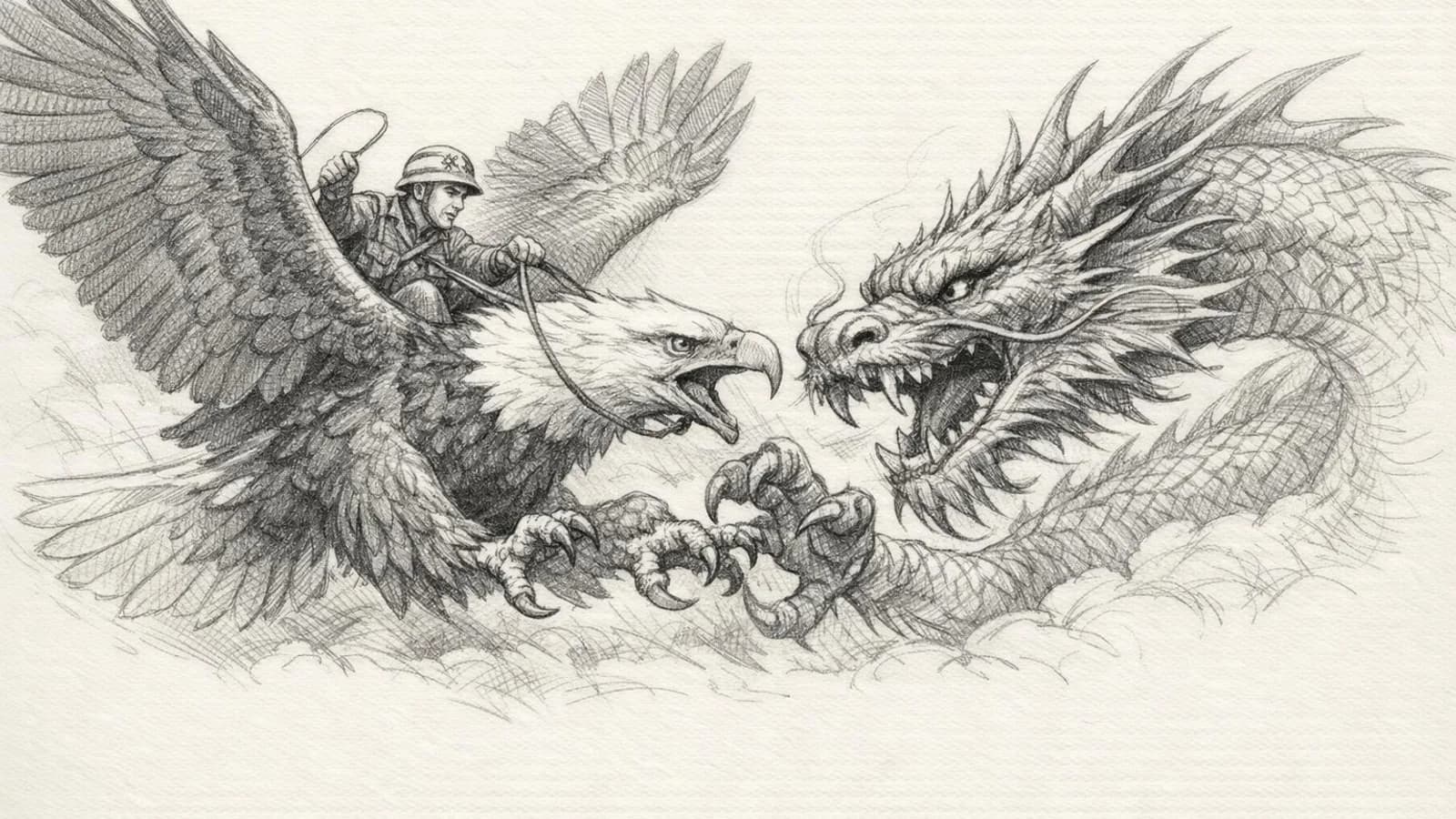
The Hidden Strategy Behind Iran, War, and Global Power
⚡Key Takeaways
- Florian Homm interprets the current conflicts as part of a global geo-strategy centered on power, energy, and weakening China.
- In his view, wars such as those in Ukraine or Venezuela are mainly a distraction; the real goal is to destabilize the Muslim world and cut off Chinese oil and trade routes.
- According to the article, the U.S. benefits as Europe’s largest LNG exporter from the energy shortage in Europe by selling expensive natural gas and securing its hegemony vis-à-vis China.
- Israel is portrayed as a geopolitical beneficiary of a fragmented region, while countries such as Iran, Syria, Libya, or Indonesia are described as nodes in a broader power struggle.
- For Germany, the article sees mainly drawbacks: high energy prices, declining competitiveness, and greater dependence on American LNG instead of cheaper Russian energy.
Florian Homm is currently going out on a limb and letting us in on his research sources. He transparently and plausibly describes the background to the Iran war and surrounding conflicts. In the end, it is about world domination and about harming China.
📚 Deep Research — Source Text
The Geopolitical World Situation: Background, Interests, and the Role of Energy
According to Florian Homm, many of the current global conflicts are based on a fundamental, often misunderstood geostrategic agenda. To support his analyses, Homm refers to an extensive database: he states that he has access to 9,437 sources, of which he regularly uses around 150 sources for his evaluations.
The true background to the global conflicts
According to Homm’s account, widely discussed conflicts such as the war in Ukraine or the crisis in Venezuela are merely geopolitical diversionary tactics. The real, overarching goal of Western intelligence services (especially the CIA, MI6, and Mossad) is the systematic weakening and destruction of China and the Muslim world.
The background is purely economic and resource-based: China sources 55% of its oil imports from the GCC states (Gulf Cooperation Council) in the Middle East, with Saudi Arabia and Iran (13%) playing central roles. The primary goal of the US and Israel is to cut off these energy supply lines in order to permanently break China’s economic rise and the Chinese-Russian alliance. To this end, targeted “dismantling” and “subversion” are being carried out in the Muslim world to Balkanize it and keep it in permanent wars.
The interests of the US and Israel
In this global “game of chess” described by Homm, the interests of the two main actors can be clearly defined:
USA: The US has a massive economic interest in global destabilization, as it became the world’s largest liquefied natural gas (LNG) exporter in 2023. It benefits directly from the energy shortage in Europe by forcing the EU to buy expensive American natural gas. It is also about maintaining global hegemony vis-à-vis China.
Israel: Israel benefits geostrategically from a fragmented and war-torn Muslim neighborhood. Economically, according to Homm (citing the CEO of Energean), Israel positions itself as the only energy-independent country in the Mediterranean region. Israel also benefits from massive financial support from the US (around 350 billion US dollars since 1946) and Germany (around 89 billion US dollars to date).
States mentioned and their geopolitical function in the conflict
Homm assigns specific roles to various states in this conflict strategy:
China: Main target of the attacks; is to be economically defeated by cutting off the oil supply from the Middle East.
Iran: Central target of Western destabilization, as the country is an important energy supplier for China and forms a neutral bridge for the Chinese Silk Road.
Saudi Arabia & Qatar: Conflict potential created by Western/Israeli intelligence services (Mossad, CIA) in order to destroy infrastructure and prevent oil transports to China.
Pakistan / Afghanistan: Conflict at the Iranian border in order to destabilize the region and disrupt Iran’s logistical connection to Asia.
Indonesia: Looming conflict (civil war/military operations) to block the maritime route of the Chinese Silk Road in the country, which is 87% Muslim.
Syria, Sudan, Nigeria, Libya, Iraq: Countries that, according to Homm, have been or are being dismantled through the targeted promotion of terrorist groups (such as ISIS, Boko Haram) by Western intelligence services in order to destabilize resource-rich Muslim states.
Turkey & Azerbaijan: States that were almost drawn into a regional war (US/Israel against Iran).
Ukraine & Venezuela: Arenas that merely serve as global distractions.
Norway: Another major beneficiary of the current global energy and gas crisis.
Russia: The alliance between Moscow and Beijing is to be broken by the conflicts.
France & Germany: Economic losers, whose political leaderships, according to Homm (e.g. Friedrich Merz / Blackrock or Emmanuel Macron / Rothschild), are deeply entangled in the interests of Western financial elites.
Effects on Germany: Energy prices and possible solutions
Homm’s remarks make clear that Germany and Europe are the economic losers in this geostrategic game. The EU now sources natural gas and crude oil worth an estimated 260 to 270 billion euros from the US; in the first quarter of 2023 alone, the figure was 23.5 billion euros.
Expected consequences and energy shortage: With the loss of cheap Russian energy imports, Germany is forced to fill its gas storage facilities with expensive American LNG. The likely consequences are permanently extremely high energy prices, which will massively damage the competitiveness of German industry (the “second most important economic nation in the EU”). According to this interpretation, the US has achieved its goal of weakening a competitor while simultaneously creating a gigantic new market for its own energy industry.
Nordstream 2 as a potential solution: If one places the interests involved in the broader geopolitical context, a clear picture emerges regarding energy infrastructure: the destruction of the cheap Eurasian energy supply (Nordstream) primarily served the economic interests of the US (as an LNG exporter) and the goal of preventing Russian-European rapprochement.
A pragmatic solution to alleviate the drastic energy shortage and reduce the enormous energy prices for the German economy and consumers would be to reopen the remaining, still intact pipe of Nordstream 2. This would reduce the massive costs of refilling gas storage facilities and lessen dependence on overpriced US fracking gas. However, such a step would directly run counter to the outlined hegemonic and economic interests of the US (sale of LNG), which is why Homm argues that the political leadership in Germany is so tied to American financial interests that rational decisions serving its own people are prevented.
❓ Frequently Asked Questions
What is Florian Homm’s analysis of the Iran war about?
According to the article, Homm assumes that the war with Iran is part of a larger geopolitical strategy. The aim is to control energy supply routes and weaken China’s economic rise.
Why does energy play such a major role in this geopolitical conflict?
The article presents energy as a central instrument of power because China depends heavily on oil imports from the Middle East. Whoever influences these supply chains can, by this logic, also put pressure on China’s economy and the Sino-Russian alliance.
What role is the U.S. said to play in the global crisis?
The U.S. is portrayed as the main beneficiary of destabilization because, as a major LNG exporter, it can sell expensive gas to Europe. At the same time, the article says this is about securing global hegemony against China.
Why is Germany a loser in this development according to the article?
According to the article, Germany loses out through the loss of cheap energy imports from Russia and its dependence on expensive U.S. LNG. This leads to permanently high energy prices and weakens industrial competitiveness.
What solution does the article propose for Germany’s energy crisis?
As a pragmatic way out, the article calls for reopening the still intact line of Nord Stream 2. This could lower energy prices and reduce dependence on overpriced LNG.
Keep reading
More from this topicMechanisms of Self-Learning AI Agents
My experiment with virtual & autonomous AI employees: cloning myself, working less, accomplishing more. An inside look at the background.
Paraguay Fish Guide - What Is There and How Good Is It?
Which fish from Paraguay are easy to digest? Our guide explains toxins, heavy metals, and omega-3s so you can make smarter choices.
Paraguay Meat Guide: How to Use Every Cut
Which cuts of meat are used in Paraguay – and what are they called? Our Paraguay meat guide explains beef, pork, lamb, and chicken in clear terms.