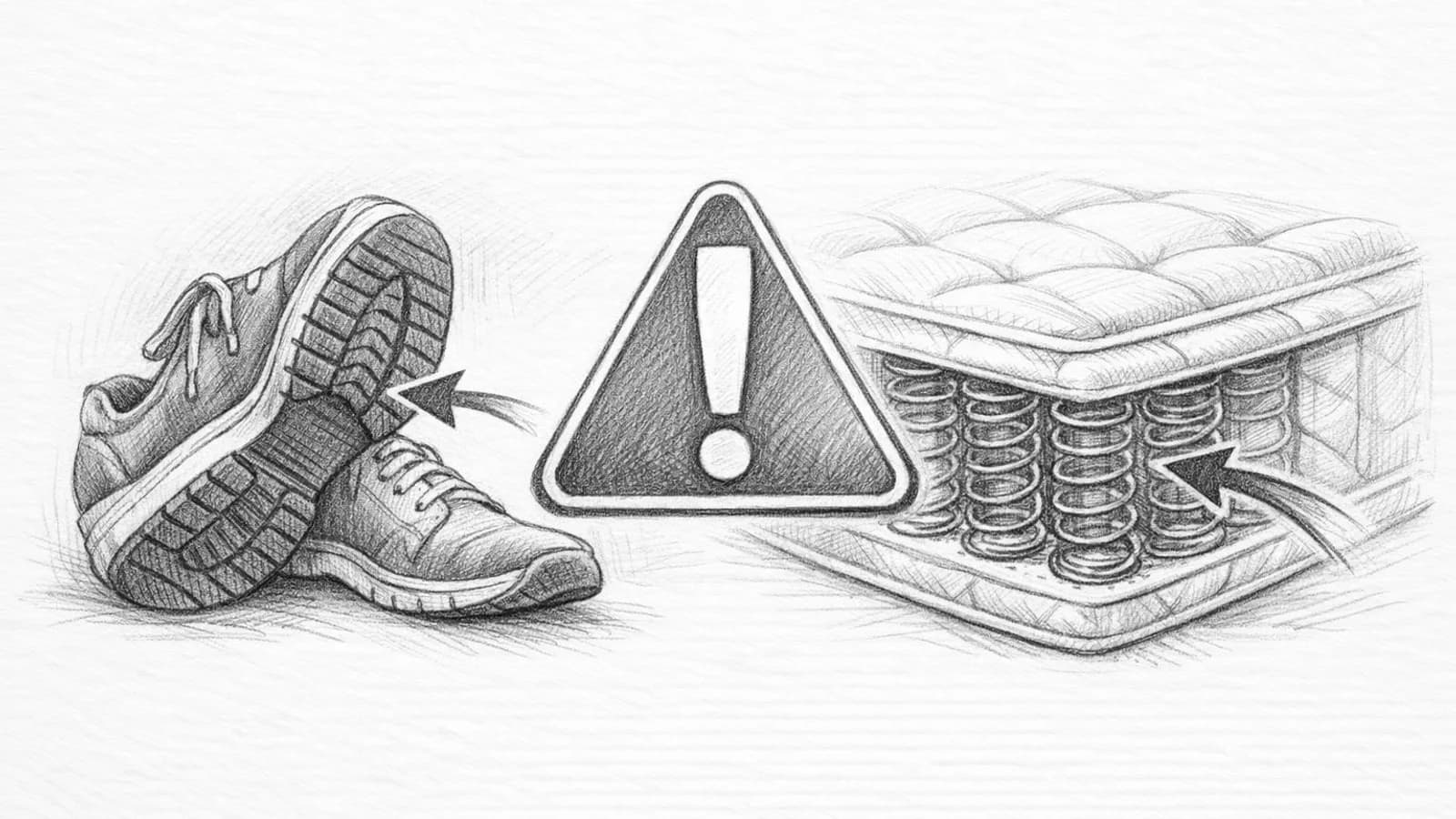
Rubber Soles & Pocket Spring Mattresses: Secretly Harmful?
⚡Key Takeaways
- The article argues that rubber soles and innerspring mattresses interrupt direct contact with the earth, thereby increasing the body’s electrical insulation.
- A possible mechanism described is earthing/grounding: through contact with the earth, the body is said to absorb free electrons that may help balance oxidative stress and inflammatory responses.
- Insulating shoe soles made of rubber or synthetic materials are portrayed as potentially less favorable than natural materials such as leather.
- Innerspring mattresses with metal coils are presented as less favorable than metal-free sleep systems because they could hinder the body’s natural electrical balancing during sleep.
- Overall, the article concludes with the practical recommendation to choose natural materials for shoes and metal-free mattresses when making new purchases.
What, in individual cases, may seem like coincidence or a historically logical development can, when put together, create an entirely new picture. In any case, I find it striking that there are developments that weaken our health and seem orchestrated.
In this case, I looked into the question of whether rubber soles under shoes and metal coils in innerspring mattresses weaken our health. I can spoil it: that appears to be the case.
That means that for future purchases in the area of shoes, I will look for soles made of natural materials, and for mattresses I will make sure they are metal-free.
Here are the results of the deep research:
📚 Deep Research — Quellentext
Health Aspects of Ground Contact: A Bioelectrical and Building Biology Analysis of Insulation Factors Through Footwear and Mattress Systems
Introduction to Bioelectrical Physiology and the Concept of Grounding
The interaction of the human organism with the Earth's natural electromagnetic and electrostatic fields is a central and increasingly debated subject of environmental medicine, bioelectromagnetics, and building biology. In recent decades, an interdisciplinary field of research has emerged that examines the physiological effects of direct physical contact with the Earth's surface—frequently referred to in the scientific literature as “earthing” or “grounding.” The physical foundation of these considerations is based on the fact that planet Earth functions like a gigantic spherical capacitor. The Earth's surface is continuously supplied globally with free, mobile electrons through constant atmospheric discharges and lightning strikes, giving it a permanent negative electrical charge. This natural charge creates a ubiquitous, weak direct-current network (DC) across the globe.
The human body, which consists to a large extent of water and dissolved electrolytes, is by nature highly conductive. Modern biophysical research postulates the existence of a so-called “living matrix” system within the body. This system is described as a body-wide collagenous and liquid-crystalline semiconductor network encompassing the extracellular matrix, the various connective tissues, and the cytoskeletons of all cells. Integrins on cell surfaces theoretically enable the semi-conduction of electrons from this extracellular matrix deep into the cell interior, the nuclear matrix, and even the genetic material itself. Historically and evolutionarily speaking, humans—by walking barefoot, wearing untreated animal skins, and sleeping in direct contact with the ground—were in a permanent electrical equilibrium with the Earth's surface. In this state, the body's electrical potential, the mucous membranes, and the venous blood rapidly equalize with that of the Earth, resulting in a measurable drop in body voltage to values in the range of about −200 mV.
With the advent of modern architecture, electrically insulating building structures, and especially shoes with thick synthetic soles as well as metal-based, insulated sleeping systems, this direct physical and electrical connection has been largely, if not completely, severed in modern industrial societies. This far-reaching separation from the Earth's geomagnetic and electrostatic field is discussed in the relevant research literature as a potential catalyst for a chronic state of “electron deficiency.” This deficiency is hypothetically associated with an increase in silent chronic inflammation, various autoimmune diseases, accelerated cellular aging, and severe sleep disturbances.
This report analyzes the specific physiological, biophysical, and biochemical effects that arise from the loss of this contact. It focuses in detail and exhaustively on two main factors of modern electrostatic isolation. First, the physical and electrical properties of shoe soles are examined, comparing natural materials such as leather with synthetic insulators such as vulcanized rubber and polyurethane. Second, the electromagnetic and static properties of innerspring mattresses (systems with metal coils) are analyzed in comparison with metal-free sleeping systems. The central aim is to provide a well-founded answer to the question of whether these modern innovations are to be classified primarily as directly harmful or whether they must at least be regarded as significantly less beneficial to human health compared with natural materials.
The Biophysics of the Inflammatory Response and Redox Balance
To assess whether insulating materials on the feet are harmful, one must first understand the underlying pathophysiological mechanism into which electrical isolation intervenes. The human organism requires direct-current energy (DC) for fundamental processes such as the heartbeat, muscle contraction, and neuronal signal transmission. The earthing hypothesis states that the body uses the ubiquitous free electrons available on the Earth's surface as a massive, natural antioxidant reservoir.
In cases of injury, infection, or physical stress such as muscle soreness (Delayed Onset Muscle Soreness, DOMS), the immune system initiates a complex inflammatory response. During this so-called “oxidative burst,” white blood cells—especially neutrophils and macrophages—invade the affected tissue and release reactive oxygen species (ROS). These ROS are free radicals—highly unstable molecules with an unpaired electron in their outer shell. Their physiological task is to destroy invading pathogens and break down necrotic tissue. In an optimally regulated, grounded system, mobile electrons flow via the living matrix network described above to the site of inflammation. These electrons pair with the free radicals and neutralize them once their primary defensive task has been fulfilled. This creates a protective antioxidant microenvironment directly around the injury site, preventing the aggressive ROS from causing “collateral damage” to adjacent, completely healthy tissue.
Preventing this natural flow of electrons through modern lifestyles—especially through insulating footwear—disrupts this essential redox balance. Without the balancing electrons from the Earth, free radicals can spread to intact tissue, leading to the destruction of cell membranes, proteins, and DNA. The body often responds to this “electron deficiency” by forming an “inflammatory barricade.” This barricade consists of a dense wall of fibrin and connective tissue that isolates the inflamed area in order to prevent systemic spread of tissue damage. Paradoxically, this very barrier limits the diffusion of circulating endogenous antioxidants into the inflamed tissue. This can mean that acute, necessary repair processes are not fully completed and instead transition into a state of “silent” or smoldering chronic inflammation. Clinical studies using medical infrared thermography have impressively demonstrated that restoring grounding leads to a rapid resolution of such chronic painful inflammatory foci, which is reflected in normalized thermal symmetry and the cooling of so-called “hot spots.” It has likewise been documented that grounding modulates the time course of immune responses to injuries, alters white blood cell concentrations, and drastically accelerates wound healing—even in diabetic ulcers that have persisted for months.
Material Physics and Electrophysiology of Footwear: Natural Leather vs. Synthetic Materials
The debate over the health implications of footwear centers on the electrical conductivity of the materials used. Electrical resistivity (also specific volume resistance, represented by the symbol ρ) is a fundamental intrinsic material property that quantifies how strongly a given material resists the flow of electric current. The inverse of this resistivity is electrical conductivity (specific conductance). Most modern shoe soles are made of synthetic polymers whose electrical properties represent fundamental barriers to bioelectricity.
Properties of Rubber Soles and Synthetic Polymers
The dominant materials in the modern shoe industry include polyurethane (PU), thermoplastic polyurethane (TPU), and vulcanized natural and synthetic rubber (Rubber, RB). These materials were developed primarily to provide mechanical comfort, extreme abrasion resistance, cushioning, waterproofing, and thermal insulation. A rubber sole, for example, offers excellent elasticity and slip resistance, while PU is especially lightweight and popular in high-end leather shoes.
From an electrical perspective, however, these synthetic polymers are nearly perfect dielectrics (insulators). Rubber and plastics almost completely prevent the passage of low-energy electrons. The resistivity of commercially available synthetic rubber soles typically lies in the range of >1012 Ω⋅cm and in some high-performance insulators even up to 1016 Ω⋅cm. This extreme resistivity is so effective that such rubber compounds are deliberately used in industry as safety footwear to protect personnel from potentially lethal electric shocks from high-voltage sources (Electrical Hazard Footwear, specified to withstand 18,000 volts at 60 hertz). Aside from special exceptions for electrostatic discharge (ESD), no ordinary street shoe made of rubber or plastic meets conductivity criteria. Even if moisture penetrates into the inside of the shoe, the vulcanized rubber barrier remains impermeable to electron transfer to the outside.
The Biophysical Anomalies of the Triboelectric Effect
The extreme insulation provided by rubber soles has, in addition to blocking Earth's electrons, another direct physical effect on the wearer: the induction of electrostatic charge. When a person wearing insulating soles walks over certain surfaces (for example, nylon carpets, epoxy floors, or sealed asphalt), friction at the interface causes the separation of electrical charges, known as the triboelectric effect. Since the soles, as insulators, prevent charge equalization with the floor, the human body—which itself is an excellent conductor—accumulates this static charge on its surface.
This friction-induced charge can quickly build to voltages of several thousand volts on the human skin. Walking with neoprene or rubber soles across a dry carpeted floor can effortlessly lead to charge accumulation of up to 20 kV. People usually notice this charge in everyday life only when it discharges abruptly through a metal object (such as a doorknob), causing a painful electric shock. From a holistic and biophysical perspective, however, this permanent state of extreme and unnatural static voltage fields on the body's surface represents a serious chronic irritation for the nervous system's sensitive electrophysiological balance.
The Conductivity and Hygroscopy of Natural Leather
The physical profile of genuine natural leather stands in sharp contrast to synthetic elastomers. Leather is not a homogeneous polymer, but a complex organic natural product created by tanning animal hides. It has a unique three-dimensional collagen fiber structure that is extremely breathable and has a natural density of about 0.95 to 1.05 g/cm3.
If leather is considered in a vacuum or in a completely dry state, it too is an extremely poor electrical conductor. Precise dielectric measurements show that the specific volume resistance of dry chrome-tanned or vegetable-tanned leather is >1016 Ω⋅cm, which effectively makes it an insulator. The dielectric constants of dry leather fibers also fall within an insulating range, at 5.4 (chrome leather) and 6.4 (vegetable leather).
The crucial difference from rubber, however, lies in leather's hygroscopy and porosity. Leather contains microscopic capillary channels that eagerly absorb water from the ambient air, and it takes up the human foot's sweat directly before slowly releasing it outward into the environment. Water—especially when it contains human electrolytes from sweat—acts as a strongly conductive medium. Scientific modeling and experimental measurements show that leather's electrical resistance drops drastically as moisture content increases. Once leather reaches a moisture content of up to 30 percent, its volume resistance drops rapidly to values of <109 Ω⋅cm.
In practical terms, this means that a pure, genuine leather sole, after a certain period of wear and break-in during which it absorbs ambient moisture and foot sweat, enables sufficient flow of electrons from the Earth's surface into the wearer's foot. Moist leather acts as a bridging medium. For this reason, genuine leather shoes are by no means capable of meeting ESD safety standards or the insulation requirements for electricians. For the practice of earthing, however, this means that historical and modern leather-soled shoes, unlike rubber or plastic shoes (including flip-flops and running shoes), largely maintain ground contact. Wood, which is occasionally used for clogs or traditional shoes, loses its natural conductivity after being cut and acts as an insulator unless it is extremely wet.
High-Tech Grounding Shoes and Conductive Rubber
It should be noted that rubber does not necessarily have to be insulating if modified industrially. The antistatic footwear industry has developed methods to dramatically reduce the inherent electrical resistance of synthetic rubber or silicone. By adding specific additives—primarily carbon black particles or metal-based nanoparticles (such as silver, copper, or aluminum)—the rubber matrix can be interrupted so that the particles form a conductive network within the polymer.
Fully conductive footwear with carbon-black soles, used for example when handling explosive materials, has an electrical resistance of under 500,000 Ω and prevents any buildup of static charge. The health and wellness industry is increasingly using this knowledge for the construction of special “earthing shoes” (such as those from brands like Harmony783 or Nefes). These shoes often combine natural leather components with strategically placed conductive carbon-rubber inserts or copper rivets in the sole, preferably in the area of the metatarsal bones. This area corresponds to the important acupuncture point Kidney 1 (Yongquan), which in Traditional Chinese Medicine and in electrophysiological research has been identified as the primary and low-resistance entry path for grounding electrons into the meridian system.
Table: Electrical and Structural Parameters of Sole Materials in the Context of Grounding
Material Type | Morphology and Water Absorption | Specific Volume Resistance (ρ) | Grounding Potential and Electrophysiology |
|---|---|---|---|
Synthetic rubber / PU | Dense polymer structure, hydrophobic, extremely low moisture absorption. | Typically >1012 Ω⋅cm, highly insulating. | Completely blocks the flow of grounding electrons. Promotes static charge buildup (up to 20 kV). |
Wood / cork | Porous, but insulating once dried. | Usually >1010 Ω⋅cm when dry. | Provides no grounding; acts as a dielectric barrier analogous to plastics. |
Natural leather (absolutely dry) | Three-dimensional collagen fiber structure, highly hygroscopic. | >1016 Ω⋅cm, temporary insulator. | In theory insulating, but in actual wear it practically never occurs because of foot sweat. |
Natural leather (practically moist) | Capillary channels filled with ambient moisture and electrolytes (sweat). | <109 Ω⋅cm at 30% moisture content. | Enables continuous electron exchange; equalizes body potential with the Earth. |
Conductive rubber (carbon black) | Synthetic matrix modified with carbon particles or metal nanoparticles. | Extreme drop in resistivity, total resistance often <500,000 Ω. | Specifically designed for grounding; maximum and immediate conductivity regardless of sweat. |
Synthesis of the Question of Whether Insulating Soles Are Harmful
When answering the question of whether insulating shoe soles are harmful or merely less beneficial, one must separate toxicology from evolutionary biology. Chemically and physically, rubber is not directly toxic to the foot in the sense of an acute poison or a pathogenic noxa. Their classification in health assessment instead lies in the category of “omission of an essential physiological symbiosis.” The harmfulness of rubber soles lies in the fact that they create an evolutionary mismatch.
By keeping the organism in a chronic state of triboelectric tension and cutting it off from the Earth's only massive, infinitely available reservoir of antioxidants, they indirectly encourage the chronicization of inflammatory processes, delay wound healing, intensify muscle soreness, and cement a disturbed autonomic nervous system. Natural leather soles, as well as metallic or carbon-doped earthing soles, restore this evolutionary normal state. Thus, wearing natural-material shoes is to be considered fundamentally more beneficial, while synthetic insulation must be classified as a silent, chronic stressor for systemic homeostasis.
Sleep Systems and Building Biology: The Electromagnetic Risk of Innerspring Mattresses
While footwear dictates interaction with the Earth during the daytime, the bed is the dominant microcosm of nighttime regeneration. Since the modern human spends statistically about one third of his or her entire life sleeping, the physical properties of the sleep environment have a cumulative and profound effect on cell metabolism and the hormonal system. Mattresses containing metal coils—such as classic innerspring mattresses, pocket-spring mattresses, or box-spring beds—are thus at the center of building biology, electrobiology, and sleep medicine criticism.
The building-biological problem of innerspring mattresses is multipolar and is essentially based on two fundamentally different biophysical phenomena: the distortion of magnetostatics (the Earth's magnetic field) and the interaction with electromagnetic alternating fields (the so-called antenna effect).
Magnetostatics: Distortion of the Natural Earth's Magnetic Field
The Earth's geomagnetic field is a ubiquitous, homogeneous, static field. In middle latitudes (such as Central Europe), this magnetic field has a natural, undisturbed flux density of around 45 μT (microtesla) at the Earth's surface. This field is extremely stable in space and time; in untouched nature there are practically no abrupt, localized fluctuations or measurable gradients over the smallest distances. Various studies show that the Earth's magnetic field is biologically highly relevant. It controls animal orientation, influences plant growth, and has measurable effects on the human organism—for example, on calcium deposition and the acceleration of bone fracture healing under certain field parameters.
The core problem with innerspring mattresses is that the thousands of spiral steel springs inside them possess ferromagnetic properties. These springs can be strongly magnetized in a variety of ways. Magnetization can already arise during manufacture when the steel is drawn and welded. But it can also be induced later, for example through the influence of direct-current fields or when the mattress is stored or used near strong permanent magnets (such as in high-performance audio speakers).
A magnetized steel spring acts like an isolated bar magnet. This creates chaotic, extremely steep magnetic field gradients in a very small space—the lying surface. Professional measurements by institutes such as Baubiologie Maes have shown that innerspring mattresses drastically superimpose and distort the natural Earth's magnetic field. While the undisturbed Earth has 45 μT, mattresses often produce fluctuations and anomalies in flux density of 2 μT to well over 50 μT in the smallest area. With a 3D magnetometer or a liquid-damped precision compass, it can be demonstrated how strong this distortion is: if one draws a compass over the lying surface of a magnetized innerspring mattress, the needle swings wildly back and forth, with documented deviations oscillating from +180° to −180°.
During sleep, people naturally move around on the mattress many times. When an electrically conductive body (the human organism with its ions and blood circulation) moves across these steep, inhomogeneous magnetic field gradients, tiny, unnatural electrical currents are inevitably induced in the cellular tissues according to the principle of induction. The well-known Wuppertal physician Dr. Dieter Aschoff explicitly warned at medical symposia that any permanent spatial disturbance of the Earth's magnetic field could become biologically risky in the long term and disrupt the sensitive electrophysiological equilibrium.
The Antenna Effect: Resonance, Standing Waves, and High-Frequency Radiation
Even more serious than the distortion of the static magnetic field is the so-called “antenna effect” of innerspring mattresses, as discussed in the electobiological literature. The physical hypothesis states that the metallic conductive structures in mattresses (both connected Bonnell spring cores and isolated pocket springs) form a resonance structure for surrounding electromagnetic fields (EMF). Since metals are excellent electrical conductors, they interact strongly with the fields emitted by everyday devices.
This first concerns low-frequency alternating electric fields (ELF), such as those emanating from the 50-hertz AC current of household wiring, electric blankets, alarm clocks, or extension cords under the bed. The metal springs capacitively attract these fields and distribute them over the entire surface of the bed, thereby artificially increasing the body voltage (measured in millivolts, mV) of the sleeper. This permanent induced voltage on the skin surface can lead to irritability of the nervous system, muscle tension, and sleep disturbances.
More contentious, but also scientifically debated, is the interaction of metal springs with high-frequency radiation (radio frequency, RF), such as that emitted by cell towers, Wi-Fi routers, radar, and FM/TV broadcast transmitters. A far-reaching and polarizing scientific study on this topic was published between 2002 and 2004 by Swedish researchers Örjan Hallberg and dermatologist Olle Johansson. They investigated a potential link between the incidence of skin melanoma and breast cancer and the use of innerspring mattresses in areas with a high density of VHF broadcast transmitters.
The physical basis of the Hallberg-Johansson hypothesis rests on antenna theory and body resonance. The torso of an adult human has an average length of about 1.5 meters. In antenna engineering, a conductive object of this length acts as an efficient half-wave dipole antenna for electromagnetic frequencies around 100 MHz. This precisely corresponds to the frequency band of Western frequency-modulated (FM) VHF radio, which operates in the 87 to 108 MHz range. When horizontally polarized radio waves strike the metal base of a bed (the innerspring mattress), the metal mesh reflects these incoming waves. Through the superposition of the incoming and reflected waves, a so-called “standing wave pattern” is formed above the mattress.
The physics of standing waves dictates that the electric field strength directly at the metallic reflection surface (the mattress surface) is reduced by cancellation to nearly zero. However, the field strength increases with vertical distance and reaches its absolute maximum at a height of one quarter of the wavelength (about 75 centimeters above the mattress surface), the so-called antinode of the standing wave. At this point, the amplitudes of the incoming and reflected waves add up, effectively doubling the field strength.
The authors linked this phenomenon to epidemiological sleep statistics. Medical literature shows that the majority of people (about 33% to 47%) prefer to sleep on their right side, probably for evolutionary reasons in order to reduce the weight burden on the heart and minimize the disturbing sound of one’s own heartbeat on the pillow. If a person sleeps on the right side, the left half of the body—especially the left breast and left torso area—is furthest from the mattress and is precisely in the zone of maximum field strength of the high-frequency standing wave (75 cm height). The right side of the body, by contrast, remains within the protective damping null zone near the mattress. Hallberg and Johansson argued that over decades this asymmetrical exposure explains the striking left dominance in breast cancer incidence (the rate is 5% to 19% higher on the left than on the right) and torso melanomas in Western countries. Their thesis was supported by an epidemiological comparison with Japan: in Japan, a lower frequency band (76 to 93 MHz) is used for FM broadcasting, which changes the resonance pattern, and the population traditionally sleeps on completely metal-free futons (shiki futons) placed directly on the floor. Accordingly, the characteristic standing waves and a left dominance in breast cancer incidence could not be demonstrated in Japan, and the general melanoma rate was only about 3% of that in Sweden.
Scientific Controversy and Media Distortion of Antenna Theory
These far-reaching and alarming postulates led to a massive outcry in the scientific community and in skeptic circles. The spread of the theory was paradoxically intensified by flawed science journalism. In a guest post on the respected Scientific American blog, neurobiologist R. Douglas Fields summarized the results of the Swedish study in a way that critics said was physically incorrect. The blog post falsely claimed that the mattress springs act as antennas that directly amplify radio waves and thus irradiate the sleeper.
Science magazines such as Discover and fact-check organizations such as Snopes had to intervene to correct the physical facts: the metal coils do not amplify the signal at the contact surface; they actually attenuate it. The danger potential postulated by Hallberg and Johansson lies exclusively in the standing-wave gradient at a distance of 75 cm. Snopes formally classified the viral claim “Coiled mattresses cause cancer by amplifying radio waves” as false, since the underlying epidemiological association study was considered “wildly speculative.” Epidemiologists criticized the study on the grounds that causal relationships can hardly be derived solely from overlaying cancer registry data and the geography of transmitter masts, especially while ignoring countless other environmental toxins, radiation sources (such as the much more dominant mobile phone signals in the UHF band), and genetic factors.
Nevertheless, apart from the debate about carcinogenic effects of VHF radio waves, the basic electobiological consensus remains unshaken: metallic structures under the sleeping person act as resonators and disturbers of electromagnetic near fields. For health-conscious consumers, the risk of placing the nervous system under chronic stress every night through capacitive coupling to household current is real and measurable.
Building-Biological Reference Values: SBM-2015 Compared with State Standards
To make the extent of electromagnetic exposure in sleeping areas tangible, the Institute of Building Biology and Sustainability (IBN), in cooperation with Baubiologie Maes, established the strict “Standard for Building Biology Testing” (SBM-2015). These guidelines focus explicitly on the sleep phase, when the organism is particularly vulnerable to physical disturbances due to parasympathetic dominance. The building-biological reference values stand in glaring, intentional contrast to state industrial standards (such as ICNIRP, BImSchV, or DIN/VDE standards). State standards are aimed exclusively at preventing acute thermal effects (tissue heating from microwaves) or acute nerve stimulation by high-current fields during short-term occupational exposure. Building-biological values, by contrast, address a-thermal, cellular, and endocrine disruptions during continuous nighttime exposure.
Detailed excerpt of the building-biological reference values for sleeping areas (SBM-2015) in the field and radiation range:
Measured Quantity (Electromagnetics & Indoor Climate) | Unremarkable | Slightly Remarkable | Highly Remarkable | Extremely Remarkable | Reference Values & State Limits |
|---|---|---|---|---|---|
Magnetostatics (Earth's magnetic field) Compass needle deviation in degrees | <1−2° | 2−10° | 10−100° | >100° | DIN/VDE 0848: Work 67.9 mT (Nature knows no such anomalies). |
Alternating electric fields (low frequency, 50 Hz) Field strength relative to earth in V/m | <1 V/m | 1−5 V/m | 5−50 V/m | >50 V/m | DIN/VDE: Work 20,000 V/m, Population 7,000 V/m. ICNIRP: 5,000 V/m. Nature: <0.0001 V/m. |
Alternating electric fields (low frequency) Body voltage relative to earth in mV | <10 mV | 10−100 mV | 100−1000 mV | >1000 mV | Body voltage rises massively on innerspring mattresses near power lines. |
Alternating magnetic fields (low frequency) Flux density in nanotesla (nT) | <20 nT | 20−100 nT | 100−500 nT | >500 nT | BImSchV: 100,000 nT. U.S. Congress EPA recommended 200 nT for children as a precaution. |
Indoor climate (indirect factors) Carbon dioxide (CO₂) in ppm | <600 ppm | 600−1000 | 1000−1500 | >1500 ppm | MAK: 5,000 ppm. Nature: ~400 ppm (as of 2015). |
The table impressively illustrates that sleep systems that cause magnetic compass deviations of over 100 degrees (as documented for strongly magnetized springs) are, from the standpoint of preventive medicine, to be classified as “extremely remarkable” and therefore in urgent need of remediation. A completely metal-free system (for example, a solid wood bed with a natural rubber or horsehair mattress) guarantees a homogeneous natural magnetic field and minimizes capacitive coupling of electric fields, contributing to an unremarkable, earth-referenced body voltage of under 10 mV.
Endocrinology and the Hormonal Effects of Metal-Free, Grounding Sleep Systems
The causal connection between the electromagnetic sleep environment and systemic health becomes evident when one considers the body's endocrinological stress axis. The hypothalamic-pituitary-adrenal axis (HPA axis) and the autonomic nervous system (ANS) react sensitively to any form of cellular stress, including invisible physical disturbances. Chronic EMF exposure, as intensified by the antenna effect of mattresses, forces the body into a mild but permanent sympathetic tone (fight-or-flight response).
A dysregulated stress system is reflected in the biochemistry of sleep. A healthy circadian rhythm is characterized by a low cortisol level at night and a steeply rising cortisol awakening response (CAR) in the morning, coupled with high evening secretion of melatonin. In patients with insomnia, chronic stress, or major depression (MDD), this diurnal curve flattens; the morning peak drops while nighttime cortisol values remain elevated, which promotes profound immunosuppression, the release of inflammatory cytokines such as interleukin-6 (IL-6), and adrenal exhaustion.
That refraining from metal in the bed and restoring ground contact intervene precisely in these biochemical regulatory circuits was examined in several recent studies—including one published in the journal Environmental Health—using the so-called HOGO system. The HOGO system is a technologically advanced sleep system that completely avoids metal components, is made entirely of natural materials, and additionally features a patented graphite-silver network that shields electromagnetic fields and directly grounds the body (dissipation of electrostatic potentials).
The clinical results of using this system were striking. In studies in which participants (men and women) slept for two months in the EMF-avoiding and grounding HOGO bed, the researchers documented drastic hormonal shifts. Compared with a placebo group, users showed a significant increase in plasma dehydroepiandrosterone (DHEA). DHEA is an essential steroid hormone produced in the adrenal gland and acts as the body's strongest endogenous antagonist to the catabolic (tissue-degrading) effects of glucocorticoids such as cortisol. A high DHEA level is an excellent biomarker of youthfulness, immune resilience, and stress tolerance.
In addition, the participants' cortisol-to-DHEA ratio decreased (demonstrating a reduction in chronic stress level), while the concentrations of neuroprotective and sleep-promoting hormones—namely melatonin (which is demonstrably suppressed by EMF), serotonin, noradrenaline, testosterone, and the bonding hormone oxytocin—increased sharply. The reduction in oxidative and inflammatory stress also slowed the cellular aging process and reduced the participants' measurable biological age.
This body of data strongly supports the building-biological postulate: innerspring mattresses are far from merely neutral or “slightly less comfortable” furnishings. Due to their physical nature as magnetic interference fields and resonators, they act as tangible chronic stressors for the endocrine system. They undermine essential parasympathetic recovery and, in direct comparison with insulating natural-material mattresses (such as latex or coconut fiber combined with grounding functionality), must be regarded as pathophysiologically dysfunctional and potentially harmful.
Methodological Critique and the Discourse of the Skeptic Community
Despite the abundance of biophysical explanatory models and small clinical studies that promote a drastic health superiority of ground contact and metal-free environments, there exists a weighty and highly articulated opposition within academic medicine. Leading skeptics, especially from the circles of Science-Based Medicine (SBM) and the magazine Skeptic, heavily criticize the research methodology and the sweeping claims of the earthing community.
The Argumentation of Science-Based Medicine (SBM)
At the center of this criticism is Dr. Steven Novella, a prominent neurologist at Yale University School of Medicine and founder of the influential Science-Based Medicine blog. Novella and his colleagues regard the entire concept of “earthing” as a textbook example of modern pseudoscience, misusing legitimate physical terminology to legitimize esoteric healing promises.
The criticism is first directed at the origins of the movement. The modern grounding doctrine was not developed in the laboratories of physiology institutes, but was introduced to the world in the early 2000s by Clint Ober, a former cable-TV installation entrepreneur. Ober observed that cable systems must be grounded to avoid signal interference and speculatively transferred this technical necessity to human biology.
According to Dr. Novella, the core assumption of earthing—that the body requires an electrical homeostasis or direct-current loop (DC) with the Earth for fundamental cellular functions—lacks any solid basis in cell biology. While it is physically undisputed that electrons flow from the Earth into the body when contact is made, and that static voltages are dissipated, Novella describes the claim that these electrons act as a universal systemic antioxidant against inflammation as unproven, reductionist speculation.
Methodological Weaknesses of Earthing Studies
Sleep researchers, clinical psychiatrists, and epidemiologists deconstruct the positive clinical studies on which proponents (and in part also this report) rely by pointing to various serious methodological flaws:
Lack of statistical power (small sample sizes): A glaring problem in almost all published grounding studies is the extremely small number of participants. Highly cited studies on cardiovascular factors or pain reduction, for instance, often examined cohorts of only 10 to 12 healthy individuals (e.g., n=10 in the study of blood viscosity). Statistical significance found in cohorts of n=10 is extremely susceptible to outliers and distorts the result (confirmation bias). Systematic reviews that aggregate these studies consistently complain that the data base is too thin to derive definitive therapeutic recommendations.
Blinding and the placebo effect: A large proportion of the reported benefits—especially pain reduction, reduced stress, and better sleep—are based on subjective, self-reported questionnaires such as the Pittsburgh Sleep Quality Index (PSQI) or visual analog scales (VAS) for pain. Dr. Greta Raglan, an expert in psychiatry, points out that interventions actively used by participants (such as sleeping on special wired mats or wearing grounding shoes) carry enormous potential for the placebo effect. The expectation of using a revolutionary product is often enough to provide short-term relief of subjective symptoms. Objective markers such as laboratory-based polysomnography (EEG brain-wave measurements in a sleep lab) are completely absent in many basic studies.
Lack of specificity and alternative explanations: Some systematic reviews and critical analyses show that two studies did report pain reduction through grounding patches, but a third was unable to demonstrate any significant differences between the blinded placebo group (non-functioning grounding cable) and the real intervention group. Critics also raise the question of whether the subjective health gains from “walking barefoot in the green” are actually induced by electron transfer, or instead by psychological relaxation, moderate exercise (nature therapy), and escaping stressful everyday work life (biophilia hypothesis).
The skepticism of the scientific mainstream is therefore deeply rooted. Physicians warn against reducing complex civilization-related diseases (such as autoimmunity, cardiovascular disease, or chronic insomnia) to a simplistic “electron deficiency” caused by rubber shoes, thereby delaying necessary evidence-based therapies.
A Biophysical Synthesis of the Discrepancies
How can the massive methodological criticisms of neurologists be reconciled with the indisputable physical facts of building biology? The consensus lies in recognizing probabilities and physical prevention.
No one in electrophysiological research disputes that rubber soles can generate up to 20 kV of static voltage on the body, which becomes painfully manifest upon discharge. No one disputes that the Earth's magnetic field is highly distorted by innerspring mattresses (over 100° compass deviation) and that metal in the bed acts as a capacitive antenna for low-frequency mains fields, which drives body voltage sharply upward.
The skeptics primarily criticize the claims of cure (the assertion that earthing heals diseases), not the physical reality of the exposure. A building-biologically sound interpretation of these data suggests that humans are not purely biochemical systems but highly bioelectrical ones as well. Eliminating constant unnatural physical disturbances—whether triboelectric continuous charge from plastic soles or low-frequency field coupling during sleep through metal springs—is a logical, causally justified preventive step (sleep hygiene), even if it is not a miracle cure for existing pathological conditions.
Conclusion and Final Assessment of the Isolation Factors
The comprehensive analysis of the literature and the biophysical data landscape regarding the effects of insulating shoe soles and innerspring mattresses on human health provides a differentiated and far-reaching answer to the question.
Assessment of insulating shoe soles (synthetic vs. leather):
Synthetic rubber soles and PU materials behave as perfect dielectric barriers that rigorously prevent any natural exchange of charge carriers between the negatively charged ground and the highly conductive human body. From a strictly toxicological and acute perspective, they are not to be classified as directly “harmful” — they do not secrete toxins into the foot. However, they are in an emphatically less beneficial position for the organism than soles made of genuine natural materials such as moist leather or modern carbon-black-enhanced conductive rubbers. By inducing potentially massive triboelectric surface charges (up to 20 kV) and completely blocking the electron flow that can serve for the preventive systemic neutralization of reactive oxygen species (ROS) during inflammatory immune responses, they promote an unnatural cellular environment. Wearing natural leather or conductive shoes restores natural electrophysiological resilience, promotes wound healing and muscle regeneration (reducing DOMS), and is therefore to be rated as physiologically significantly more beneficial.
Assessment of innerspring mattresses (metal coils vs. natural/metal-free):
The influence of metal-based mattress systems on nighttime regeneration must be judged far more critically. Steel coils inside mattresses are not passive insulation, but active physical interference sources. They drastically distort the natural, homogeneous Earth's magnetic field and create chaotic anomalies classified by building biology (SBM-2015) as “extremely remarkable.” In addition, the metal components demonstrably function as capacitive antennas for low-frequency household electric fields, measurably increasing body voltage, and provide resonance spaces (standing-wave formation) for high-frequency radiation fields.
This sum of artificial electromagnetic disturbances during the most sensitive and longest regeneration phase of the human being induces subtle but chronic stress on the hypothalamic-pituitary-adrenal axis (HPA). Clinical control studies with metal-free sleeping systems show that removing these EMF stressors normalizes cortisol levels, increases anti-aging hormones such as DHEA and melatonin, and significantly improves immunological functionality. From the perspective of electobiology, endocrinology, and building biology, an innerspring mattress is therefore not merely less beneficial, but must be regarded as potentially harmful, because it undermines sleep architecture through permanent physical irritation. The consistent avoidance of metal in the bed in favor of pure natural materials (such as natural latex, coconut fiber, or wood) is a strongly recommended measure of preventive health care.
The effects of grounding (earthing) on inflammation, the immune ...
Practical applications of grounding to support health - PMC - NIH
Are We Losing Our Connection? Our Rubber Soles and the Ground Beneath Us
Discharging Body Electricity with Handcrafted Grounding Shoes
Grounding aka Earthing is Based on Bad Science - Blog - Women of Grace - www.womenofgrace.com
What Are Earthing Shoes and How Do They Work? - Bearefoot
Electrical resistivity and conductivity - Wikipedia
US7424782B2 - Electrically conductive shoe and system - Google Patents
Rubber Options: Is Silicone Conductive?
Antistatic vs Non-Conductive vs Conductive - ProFit Footwear - PPE Safety Shoes
Comprehensive Guide to Shoe Soles - Knowledge - Huangxuan
is it true rubber soles on our shoes prevent us from absorbing earth's energy?
What Materials Are Conductive? - Healthy & Grounded
How much electricity do rubber shoe soles conduct? - Electronics Stack Exchange
Volume Resistivity - Precision Ceramics
What Footwear Do I Wear? - e-Hazard
Influence of Temperature and Moisture on the Electrical Properties of Leather
Introduction To Conductive Rubber - Industry Information - News - Linde Seals
Achieving High Electrical Resistivity in Rubber Compounds - Birla Carbon
Earthing: Health Implications of Reconnecting the Human Body to the Earth's Surface Electrons - PMC
Do Coil Mattresses Cause Cancer by Amplifying Radio Waves? - Snopes.com
Experience - HOGO International
Does Innerspring Mattress Pose An EMF Health Risk? Exploring ...
Innerspring Mattresses - Association for Building Biology
Innerspring: Wired Even at Night - Building Biology Maes
Sleeping Metal-Free – for Peace & Natural Well-Being - Allnatura
Do Metal Coils in Mattresses Attract EMFs? What the Science Says - LeafScore
Do Metal Bed Supports Boost Cancer Rates? | TV Tech - TVTechnology
Cancer versus FM radio polarization types - PubMed
Cancer incidence vs. population average sleep duration on spring mattresses - m-hikari.com
Cancer and body height - PubMed
Sleep on the right side—Get cancer on the left?
Standard of Building Biology Measurement Technique - Woonbiologie.eu
GUIDELINES - Institute of Building Biology + Sustainability IBN
The use of a bed with an insulating system of electromagnetic fields ...
HOGO system structure and materials | Download Scientific Diagram - ResearchGate
Science-Based Medicine - Wikipedia
Can 'Grounding' Sheets Actually Help Me Sleep? - Research
By request: I am Steven Novella of The Skeptics' Guide to the Universe. AMA - Reddit
Does Grounding to the Earth Reduce Subjective Experience of Pain? - DigitalCommons@PCOM
"Does Grounding to the Earth Reduce Subjective Experience of Pain?" by Adam Umbro
The Science of Earthing and Are Grounding Shoes a Scam? - YouTube
❓ Frequently Asked Questions
Are rubber soles harmful to health according to the article?
The article suggests that rubber soles insulate the body from the earth and could therefore hinder the body’s natural electrical balance. This is not presented as a proven direct harm, but rather as something interpreted as less favorable for health.
Why are innerspring mattresses considered problematic?
The article describes metal coils in innerspring mattresses as a possible insulating and disruptive factor. For that reason, metal-free sleep systems are presented as the better alternative in terms of grounding and sleep health.
What does earthing or grounding mean?
Earthing or grounding refers to the direct physical contact of the body with the earth’s surface. According to the article, this contact is supposed to help the body absorb free electrons and reduce oxidative processes and inflammation.
Keep reading
More from this topicWhat Florian Homm Says About the Elite
→ Florian Homm and the Elite: as thrilling as a crime novel. In our deep research, we summarize his statements with facts and sources. Read now!
Summary by Alexander Laurent
Alexander Laurent describes the world as an AI simulation. In this article, I summarize the key points of the four videos without evaluating them.
Vera F. Birkenbihl: Learning Methods That Really Make a Difference
Vera F. Birkenbihl: Which learning methods still work today, how they change your learning, and what really matters in everyday life.