What Florian Homm Says About the Elite
⚡Key Takeaways
- The article portrays Florian Homm as a credible insider who not only criticizes the elite from the outside, but describes its structures from personal experience.
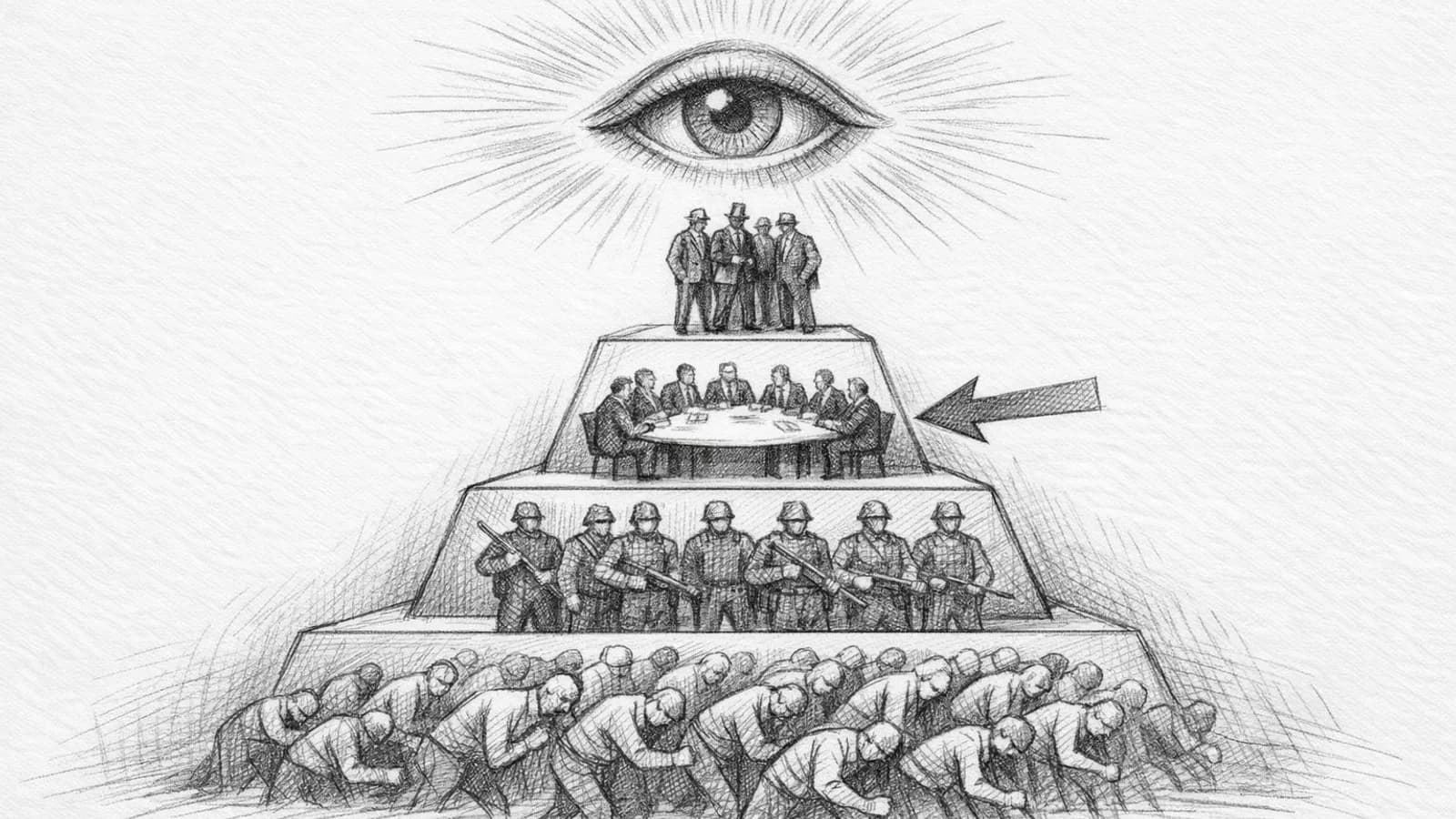
- The central thesis is a hierarchical order of power: according to Homm, even hedge fund managers are often only executors, while real control lies with a smaller group of "architects."
- The elite stabilizes its power through a "pseudo-reality": manipulation, distraction, and the impression that power relations are natural or meritocratic.
- Homm warns that the decisive power of the future will lie less in traditional financial centers and more in control of AGI, robotics, and algorithmic systems.
- The text interprets Homm's exit as a multi-stage distancing from the financial world, elite behavior, and alternative echo chambers — linked to a systemic critique of capitalism.
There are opinions and there are facts. There are windbags and there are real witnesses.
I consider Floriam Homm to be a real insider when it comes to the elite. What he said has substance. It matches much of what I had previously suspected, but coming from his mouth it is once again far more credible.
I’m sharing with you here a deep research piece I created on his statements regarding the “elite.” Fascinating like a crime thriller, but probably more real...
📚 Deep Research — Source Text
Phenomenology of Power: A Deep-Analytical Exegesis of Florian Homm’s System Critique and Transformation
1. Introduction: The Defector as an Archetypal Figure of Enlightenment
The figure of Florian Homm represents a fascination in contemporary discourse on global power structures that eludes simple categorization. He is neither merely the redeemed former billionaire nor simply another conspiracy theorist. Rather, he embodies the archetype of the “defector” — an actor who not only observed but actively helped shape the deepest inner circles of power, only to subsequently turn against precisely those structures that created him. This analysis is dedicated to an exhaustive examination of his statements, based on a hermeneutic evaluation of his media trail.
The aim of this report is to weave the fragmented insights Homm has granted in various interviews and publications into a coherent theoretical framework. The focus is not biographical sensation-seeking, but the structural analysis of the “elite” as Homm describes it. His narrative offers a rare inside view — a phenomenology of power that ranges from the psychic conditioning of the individual to the macroeconomic architecture of a “simulated reality.”
Particularly significant here is the tripartite nature of his “exit”: the physical exit from the financial world (through flight and imprisonment), the psychological exit from the behavioral patterns of the elite (through illness and purification), and finally the ideological exit from the echo chambers of alternative media. This analysis will show that Homm’s criticism goes far beyond the usual narratives of “greed” and instead describes a systemic dystopia in which freedom is an illusion and power a pathological state.
2. The Morphology of the Elite: Structure, Hierarchy, and “Simulated Reality”
The analysis of Homm’s terminology reveals that the term “elite” in his vocabulary does not describe a homogeneous mass. Rather, he sketches a highly complex, stratified architecture of power defined less by wealth than by access to the “production of reality.”
2.1. The Stratification of Power: Managers vs. Architects
One of the most fundamental distinctions Homm makes is between the operative and strategic levels of power. In his remarks, it becomes clear that even a “hedge fund manager” — a position often regarded in the public mind as the top of the food chain — occupies merely a functional role within a larger apparatus.
Homm describes his own former position as part of the elite, one that “knows the rules of the powerful first-hand.” But it is crucial to note that “knowing” is not the same as “setting” them. The managerial level to which Homm belonged has executive power and enormous resources (“awesome resources”), but operates within a corridor defined by an even more exclusive group. This higher level, which Homm often implicitly refers to as the “architects” or “those up there,” operates beyond mere capital accumulation. Its currency is not money, but interpretive sovereignty over reality.
This differentiation is essential for contextualizing Homm’s statements about the “world conspiracy.” When he states, “The world conspiracy is real,” he is not necessarily referring to crude backroom collusion, but to the systematic convergence of interests at the level of the “architects,” which is executed by the “managers.” The managers are the Praetorian guard of the system — highly paid, privileged, but ultimately replaceable and subject to the same wear and tear as the rank and file, only at a higher level.
2.2. The Construction of “Simulated Reality”
A recurring motif in Homm’s narrative is the concept of “simulated reality.” This goes beyond the Marxist notion of “false consciousness” and moves closer to Baudrillardian simulation theories. The elite secures its power not primarily through physical repression (though this exists as ultima ratio, as Homm learned through his arrest), but through the creation of an artificial normality.
This simulated reality serves to keep the masses in a state of passive acceptance. Targeted manipulation determines the lives of the majority. The elite acts as the director of a global theater. For the analyst, this means: what appears in the news as “market movement” or “political coincidence” is often the result of calculated intervention by those who act “behind the scenes of power.”
The function of this simulated reality is twofold:
Distraction: It binds the cognitive resources of the population in staged conflicts and consumption cycles.
Legitimation: It makes the distribution of power appear “natural” or “meritocratic,” even though, according to Homm, it is the result of deliberate monopolization and manipulation.
2.3. The “Gorilla Theory” and the Technological Future of Rule
Homm also extends his analysis of power structures into the technological dimension, particularly with regard to artificial intelligence (AGI) and robotics. His mention of the “gorilla theory” is highly alarming in this context and revealing of the elite’s mindset.
At its core, the gorilla theory states that an intellectually inferior species (the gorilla) may indeed be physically stronger, but is inevitably dominated by the intellectually superior human. If this is transferred to the relationship between humans and AGI (Artificial General Intelligence), humanity faces the fate of the gorilla: we will become supervised, irrelevant biomass in a system controlled by a superior intelligence.
For the elite, this represents an existential turning point. The center of power in the future will no longer lie on Wall Street, but in the server farms of those who control AGI. Whoever masters this technology no longer dominates “simulated reality” through media manipulation alone, but through algorithmic supremacy. The debate over “liability issues in robot damage” or the “Unitree G1 example” are not technical annoyances, but harbingers of a new legal and social order in which autonomous systems act. The elite is preparing to manage this transition — and to ensure that it stands on the side of the tamers, not the gorillas.
3. The Psychodynamics of the Elite: Selection, Conditioning, and Pathology
One of the most shocking insights from Homm’s accounts is that entry into the elite requires not only intelligence or capital, but a specific psychic constitution — and the willingness to have it systematically distorted. Homm paints the picture of a caste shaped by trauma and selection.
3.1. “Talent Tests” and the Selection of Sociopaths
Homm provides a rare glimpse into the recruitment mechanisms that take effect as early as youth. He describes an episode on the Feldberg, in a tower, where he had to undergo so-called “talent tests.” These tests were superficially disguised as educational exercises (e.g. making paper airplanes), but in fact served to identify specific personality traits.
The anecdote is difficult to surpass in its symbolism: while other children dutifully tried to fold the most aerodynamic paper airplanes according to instructions, Homm refused this conformity. He was “close to nature,” preferred being by the stream instead of “hanging out with educators” and “the other kids who were psycho too.” His solution to the competition of who could make the plane fly the farthest: he drew a plane on a piece of paper, wrapped a stone inside it, and threw the bundle through the closed window (or opened it; the narrative implies violence against the structure).
The result: “I won, didn’t I? It’s a plane too, a flying object.”
This episode reveals three core criteria for elite recruitment:
Disruptive thinking: The ability to prioritize the goal (distance of the throw) over the rules (folding paper airplanes).
Ruthlessness: The willingness to destroy structures (the window, the rules) in order to win.
Results orientation: The system rewards the outcome, not the process. The stone wrapped in paper flew the farthest.
Homm himself reflects on this critically as evidence that he and the other children were “psycho.” The system does not seek balanced, empathetic personalities. It seeks highly functional deviants whose energy can be channeled.
3.2. MK Ultra and the Programming of the Individual
The picture becomes even darker when Homm explicitly uses terms like “MK Ultra – the elite program.” Regardless of whether he means this as a historical reference to CIA programs or as a metaphor for modern conditioning methods, the message is clear: members of the elite are “programmed.”
He speaks of “great mental strain” and “abuse strain.” The question “How is a child supposed to bear that?” points to traumatic processes designed to harden or split the individual. Only those who can “bear” these strains are suitable. Those who break, “well, it didn’t work out.” This is a Darwinian selection based on psychological resilience under extreme, often abusive conditions. In this reading, the elite is not only perpetrator, but also the product of institutionalized abuse that extinguishes empathy and maximizes functionality.
3.3. The Psychosomatic Tribute: The Body as Accuser
The price of belonging is physical decay. Homm describes his body as the battlefield of his career. “At 40 I had multiple sclerosis, damn it,” he almost shouts. His sister died of MS at 49. He draws a direct causal link between life at the “absolute peak of the pyramid” and the collapse of biological systems.
Stress, the constant chase (“hardcore business”), the paranoid fear of falling — all of it manifests somatically. The wealth, the “high double-digit millions,” still frozen in Switzerland, could not stop this decline. On the contrary: the money was the pain compensation for self-destruction.
4. Economic Mechanisms of Rule: Monopoly as Imperative
Beyond the psychological dimension, Homm also offers a clear economic analysis of power. In his teachings for the “Florian Homm Academy,” a doctrine crystallizes that strongly resembles Peter Thiel’s theses (“Zero to One”): competition is for losers. True power lies in monopoly.
4.1. The Bipolarity of the Market
Homm divides the market of NASDAQ companies rigidly into two classes:
The monopolists: companies with “market power” and a “competitive advantage.” They are the vehicles of the elite. To invest in them means attaching oneself to the power structure. They dictate prices, conditions, and realities.
The non-monopolists: these companies struggle in an “increasingly monopolized market environment.” They are the pool of assets to be disposed of. Investments here require a “differentiated view,” and are therefore risky.
This economic perspective reflects the social one: there are the architects (monopolists) and the masses (competitors). Wealth preservation and accumulation only work through identification with monopoly structures. The elite tolerates no free market; it tolerates only markets it controls.
5. Anatomy of the Exit: A Chronology of Failure and Transformation
The term “exit” is multilayered in Homm’s case. It does not describe a single act, but a painful process that stretches over decades and passes through various stages. It is an odyssey from absolute power into absolute powerlessness and ultimately into a new form of autonomy.
5.1. Phase I: The Failed Exit and the Flight (2007–2013)
Homm openly admits: “I did try to get out. I completely failed at it.” Unlike his wife, who succeeded in a quiet withdrawal, Homm was too deeply entangled. The attempt to leave the system triggered its defensive mechanisms.
The disappearance (2007): Going underground marked the beginning of a five-year manhunt. He ended up on the FBI’s “Most Wanted” list. This marks the moment when the “manager” becomes an “enemy of the state” as soon as he is no longer functional or breaks the rules (loyalty).
The hunt: Homm describes this period as living in a “crime thriller.” Arrested by a special unit, feared by DAX managers. The bounty underscores that this was not merely about justice, but about making an example. No one leaves the elite unpunished.
5.2. Phase II: The Zero Point — Imprisonment and Catharsis
The turning point came in 2013 with his arrest in Florence by an Italian elite unit. Homm describes the following 14 months in prison with violent criminals as the actual watershed moment.
A particularly vivid image is the scene with the “two pills in the toilet.” “Then the thing was in there, the two pills were in the toilet, that was it.” This cryptic statement can be interpreted as the moment in which he made a decision about life and death — probably the disposal of suicide pills or drugs, a symbol of the decision to face fate rather than flee.
Imprisonment forced withdrawal from the drug called “power.” It broke the conditioning. In retrospect, Homm describes gratitude for this “second life,” which is so fundamentally different from the first.
5.3. Phase III: The Second Exit — Turning Away from the “Alternative Mainstream”
A frequently overlooked but analytically highly relevant aspect is Homm’s “second exit.” After establishing himself as a critic of the system and being celebrated in the “alternative media scene” (lateral thinkers, system critics), he distanced himself from this group as well.
In conversation with Stephan Bartunek, he addresses the “exit from alternative media.” His reasoning testifies to a differentiated worldview:
Critique of radicalization: He did not want to keep watching the scene’s radicalization “without intervening.”
Lack of understanding: He missed understanding for his differentiated positions. The alternative scene often demanded as blind a loyalty to its narratives as the mainstream did.
Beyond woke and anger: In response to the question “Are you woke?” or whether he wants to “compensate for a guilty conscience,” he positions himself in a “third space.” He rejects the establishment’s “woke” culture, but just as much the dull rage of conspiracy ideologues.
This second exit gives his position credibility. He is not an opportunist who merely switched camps in order to become a new guru there. He is willing to offend his new audience as well if the truth (as he sees it) requires it.
6. Synthesis: The Motivations and the Impossibility of Escape
In summary, three central theses of motivation can be derived from the analyses of the transcripts, which determine the actions of the elite and Homm’s fate.
6.1. The Motivation of the Elite: Fear and Control
The driving force of the elite is not greed (they already have enough money), but fear. Fear of losing control, fear of “the mob,” fear of the future (gorilla theory). The construction of “simulated reality” and monopolization are bulwarks against chaos. Conditioning (MK Ultra, talent tests) serves to create people who defend these bulwarks ruthlessly.
6.2. The Price of Knowledge
Homm’s life demonstrates that knowledge is a burden in the system of the elite. Whoever has “dove deeper into the power structures” cannot simply leave. Knowledge binds. Exiting is a breach of contract punished with existential destruction (character assassination, imprisonment, illness).
6.3. The Dialectic of Freedom
Homm’s ultimate lesson is that true freedom lies neither in being a billionaire nor in the role of a celebrated guru. Freedom arises in the moment of “letting go” — whether it is letting go of status (through imprisonment), letting go of resentment (through gratitude), or letting go of followers (through criticism of one’s own scene). His “second life” in the “nonprofit creative sector” is the attempt to use the skills of the first life (analysis, strategy, toughness) for something constructive, without becoming enslaved again.
Florian Homm remains an ambivalent figure: a perpetrator who became a victim in order to return as a witness. His accounts are warnings from the engine room of late capitalism — a diagnosis stating that the system not only makes the exploited sick, but also corrodes the exploiters themselves.
145 Ex-billionaire: The world conspiracy is real (Florian Homm) - Apple Podcasts
ASK A BILLIONAIRE | Florian Homm on the road to wealth & escaping the FBI - YouTube
Ex-billionaire: The world conspiracy is real (Florian Homm) - YouTube
When the majority society becomes the enemy image: “Defector” Stephan Bartunek reports - YouTube
❓ Frequently Asked Questions
What does Florian Homm say about the elite?
Florian Homm describes the elite as a hierarchical power structure in which not all participants are real decision-makers. In his view, many managers merely implement decisions, while a smaller layer determines the rules and how reality is interpreted.
What does Homm mean by "pseudo-reality"?
"Pseudo-reality" refers to an artificially created normality that obscures power relations. According to the article, it serves to keep people passive through distraction, consumerism, and staged conflicts.
Why is Florian Homm considered a credible insider?
The article sees Homm as credible because he was once part of the financial elite and speaks about power structures from personal experience. His statements are therefore read as an inside view of the elite, not just external criticism.
What role do AI, AGI, and robotics play in Homm's analysis?
Homm sees AGI and robotics as a potential future lever of power. According to the analysis, whoever controls these technologies can dominate not only markets, but also perception and social processes.
Keep reading
More from this topicSummary by Alexander Laurent
Alexander Laurent describes the world as an AI simulation. In this article, I summarize the key points of the four videos without evaluating them.
Mechanisms of Self-Learning AI Agents
My experiment with virtual & autonomous AI employees: cloning myself, working less, accomplishing more. An inside look at the background.
Paraguay Fish Guide - What Is There and How Good Is It?
Which fish from Paraguay are easy to digest? Our guide explains toxins, heavy metals, and omega-3s so you can make smarter choices.